
Armoured Cable vs Unarmoured Cable: Key Differences, Pros & Cons
2026-07-31
Modern electrical infrastructure depends heavily on reliable cable systems capable of operating safely in diverse environmental and industrial conditions. One of the most important engineering decisions in cable selection is determining whether armoured cable or unarmoured cable is the better solution for a specific application.
Both cable types are widely used across power distribution, industrial systems, renewable energy projects, telecommunications infrastructure, and commercial electrical installations. However, they differ significantly in mechanical protection, installation requirements, environmental resistance, cost structure, and long-term operational performance.
Armoured cables incorporate additional protective metallic layers designed to withstand:
- Mechanical impact
- Compression
- Rodent damage
- Underground installation stress
- Harsh industrial conditions
Unarmoured cables, by contrast, are lighter, more flexible, and typically used where external mechanical protection is unnecessary.
The increasing expansion of modern electrical infrastructure — including renewable energy systems, data centers, underground transmission networks, and industrial automation — continues driving demand for both armoured electrical cable and unarmoured power cable systems.
1. What Is Armoured Cable?
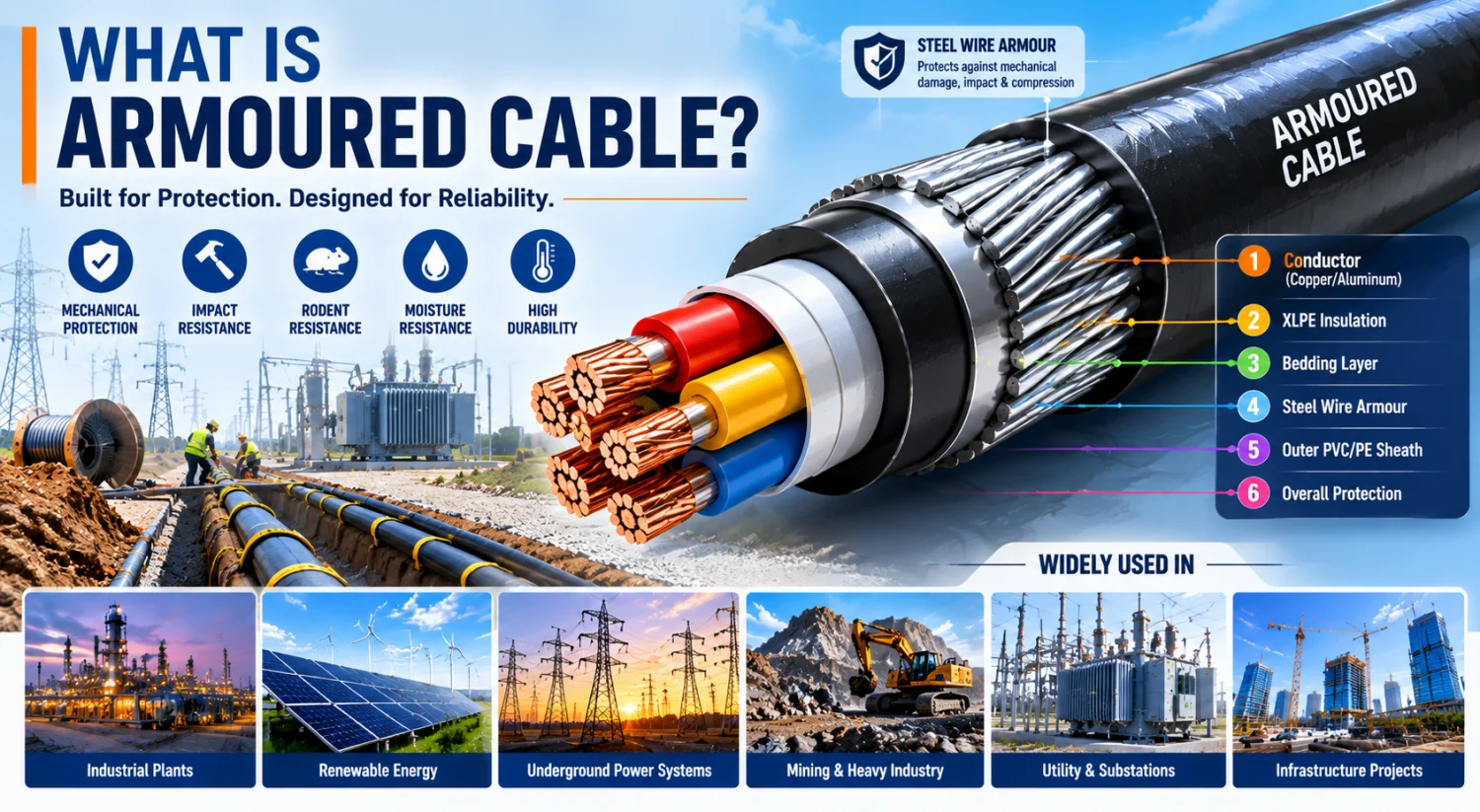
Armoured cable is an electrical cable protected by an additional metallic armor layer surrounding the insulated conductors.
This armor layer improves cable durability and provides mechanical protection against external physical damage.
Main Structure of Armoured Cable
A typical armoured power cable includes:
- Conductor
- Insulation layer
- Bedding layer
- Metallic armor
- Outer sheath
The armor is commonly manufactured from:
- Steel wire
- Steel tape
- Aluminum wire
- Aluminum tape
The most common industrial design is the Steel Wire Armoured (SWA) cable.
Purpose of Cable Armoring
The armor layer protects the cable from:
- Mechanical impact
- Crushing forces
- Abrasion
- Rodent attacks
- Underground installation stress
This makes armoured electrical cable suitable for harsh industrial and outdoor environments.
Common Types of Armoured Cables
Widely used armoured cable systems include:
- Armoured XLPE cable
- Steel wire armoured cable
- Armoured fiber cable
- Armoured Cat6 cable
- Medium voltage armoured cable
- Underground armoured power cable
XLPE Armoured Power Cable
Armoured XLPE cable systems are particularly common in medium and high voltage electrical infrastructure due to their:
- Excellent thermal performance
- High insulation resistance
- Long service life
- Moisture resistance
XLPE power cable technology has become a global standard in modern utility and industrial power systems.
Table: Common XLPE Power Cable Configurations
|
Cable Type |
Voltage Range |
Armour Type |
Main Applications |
Key Advantages |
|
Armoured XLPE Cable |
0.6/1 kV – 35 kV |
Steel wire armour |
Underground power distribution |
High mechanical protection |
|
Unarmoured XLPE Cable |
0.6/1 kV – 35 kV |
No armour |
Indoor industrial wiring |
Flexible installation |
|
XLPE Medium Voltage Cable |
6 kV – 35 kV |
Steel tape or wire armour |
Utility substations |
Excellent thermal performance |
|
XLPE Low Voltage Cable |
600 V – 1 kV |
Optional armour |
Commercial buildings |
Cost-effective distribution |
|
Armoured Fiber Cable |
Low-voltage communication |
Steel tape armour |
Outdoor telecom systems |
Rodent resistance |
|
Armoured Cat6 Cable |
Ethernet systems |
Aluminum or steel shielding |
Industrial networking |
EMI protection |
2. What Is Unarmoured Cable?
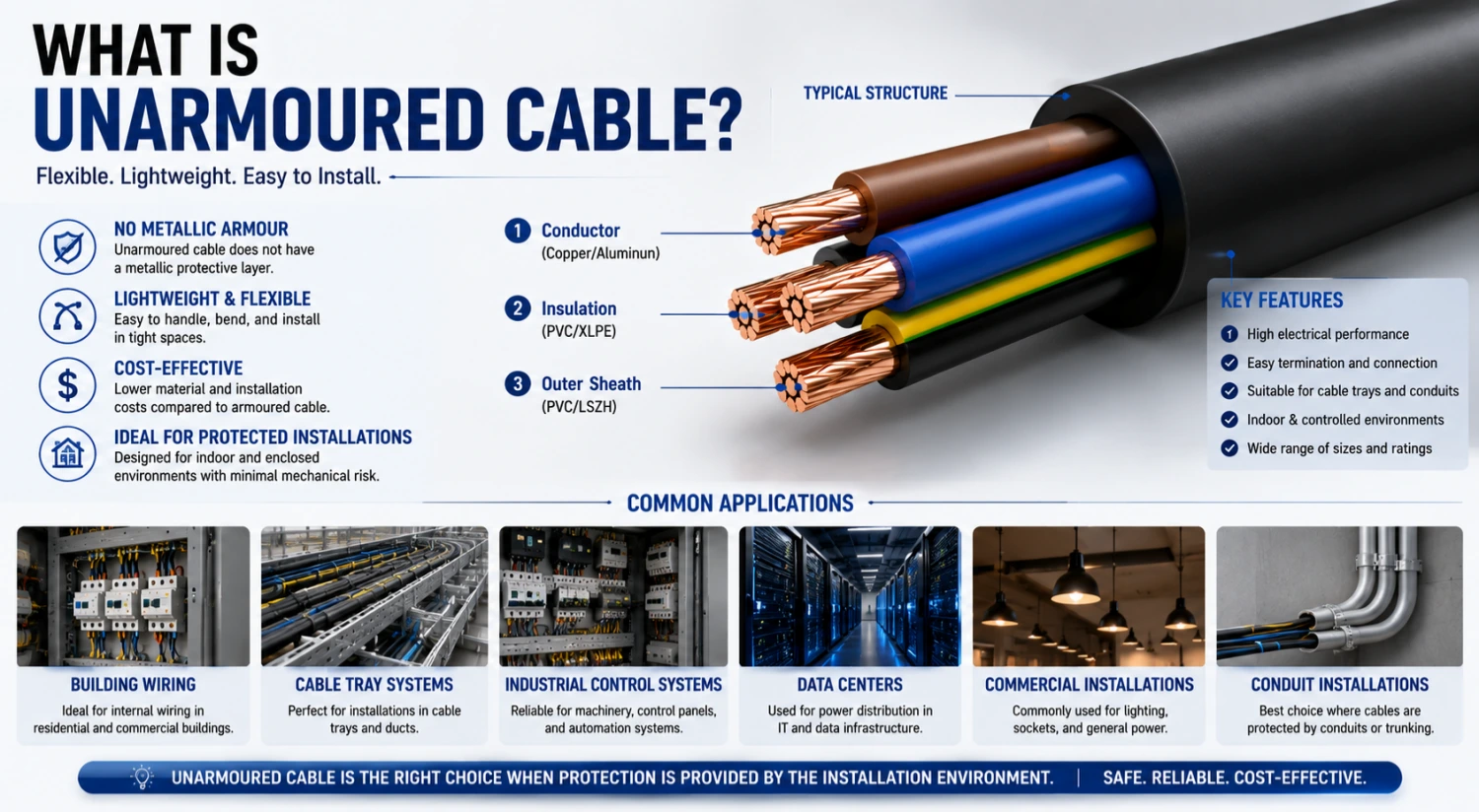
An unarmoured cable is an electrical cable without a metallic protective armor layer.
These cables rely mainly on insulation and outer sheath materials for protection.
Structure of Unarmoured Cable
Typical unarmoured power cable construction includes:
- Conductor
- Insulation
- Outer sheath
Without metallic armor, these cables are:
- Lighter
- More flexible
- Easier to install
Common Applications of Unarmoured Cable
Unarmoured cable systems are typically used in:
- Indoor installations
- Cable trays
- Electrical panels
- Building wiring
- Protected conduit systems
Unarmoured XLPE Cable
Unarmoured XLPE cable is widely used in industrial facilities where mechanical protection is already provided through conduits, ducts, or cable trays.
These systems still provide excellent electrical performance while reducing overall cable weight and installation cost.
Advantages of Flexible Installation
Compared to armoured cables, unarmoured systems are easier to bend and route through confined spaces.
This makes them highly suitable for:
- Commercial buildings
- Data centers
- Industrial control systems
- Telecommunications infrastructure
3. Key Differences Between Armoured and Unarmoured Cable
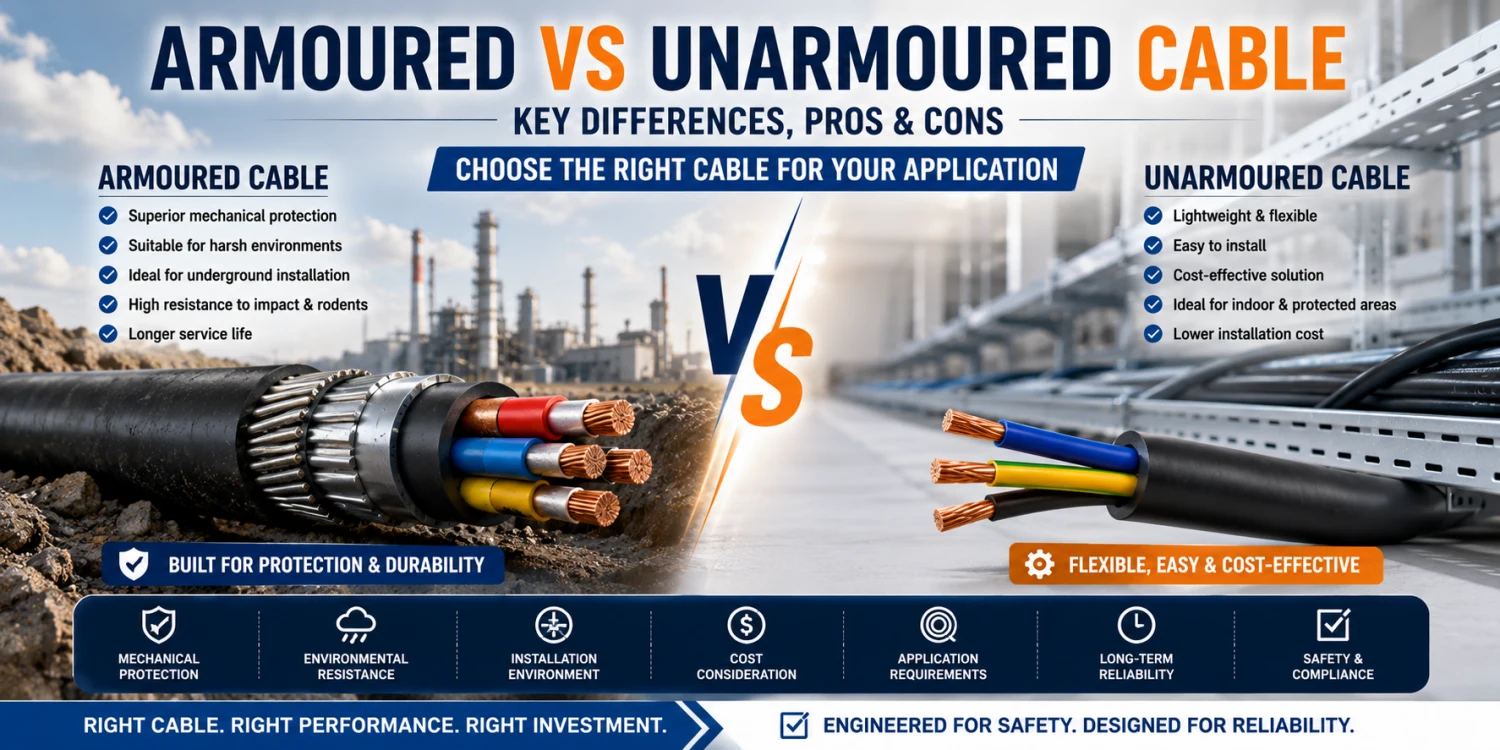
The primary difference between armoured and unarmoured cable lies in mechanical protection capability.
However, several other technical factors also influence cable selection.
Table: Armoured Cable vs Unarmoured Cable Comparison
|
Parameter |
Armoured Cable |
Unarmoured Cable |
|
Mechanical Protection |
Excellent |
Limited |
|
Installation Environment |
Outdoor and underground |
Indoor and protected areas |
|
Cable Weight |
Heavier |
Lighter |
|
Flexibility |
Lower |
Higher |
|
Installation Complexity |
Higher |
Easier |
|
Rodent Resistance |
Excellent |
Limited |
|
Direct Burial Capability |
Suitable |
Requires conduit protection |
|
Cost |
Higher |
Lower |
|
Typical Applications |
Industrial power distribution |
Commercial and building wiring |
|
Maintenance Durability |
High |
Moderate |
Mechanical Protection
Armoured cable provides significantly higher resistance to:
- Physical impact
- Compression
- External stress
- Rodent damage
Unarmoured cable offers limited mechanical protection and generally requires additional installation safeguards.
Installation Environment
Armoured cables are commonly used in:
- Underground systems
- Outdoor infrastructure
- Heavy industrial facilities
- Utility power networks
Unarmoured cables are preferred in:
- Indoor installations
- Controlled environments
- Protected cable routing systems
Flexibility
Unarmoured cables are more flexible because they lack metallic armor layers.
This simplifies installation in confined spaces and reduces labor requirements.
Weight and Handling
Armoured power cable systems are heavier and more difficult to transport and install.
Unarmoured cables reduce:
- Transportation cost
- Installation complexity
- Cable support requirements
Grounding Requirements
Certain electrical armoured cable systems require proper grounding of metallic armour for safety and fault protection.
This adds additional installation considerations.
4. Advantages and Disadvantages of Armoured Cable
Armoured cables offer major operational benefits but also introduce certain engineering trade-offs.
Advantages of Armoured Cable
Superior Mechanical Protection
Armoured cable systems perform exceptionally well in harsh industrial conditions.
Improved Underground Installation Safety
Armored cable is widely used for direct burial applications because the armor protects against soil pressure and accidental excavation damage.
Enhanced Durability
Armoured XLPE cable systems can operate reliably for decades under demanding environmental conditions.
Better Rodent Resistance
Metallic armor reduces the risk of rodent damage in underground or outdoor installations.
Disadvantages of Armoured Cable
Higher Cost
The price difference between armoured and unarmoured cable can be significant due to additional metallic materials and manufacturing complexity.
Increased Weight
Heavy cable structures increase installation difficulty and support requirements.
Reduced Flexibility
Armoured cables are more difficult to bend and terminate.
5. Advantages and Disadvantages of Unarmoured Cable
Unarmoured cable systems provide cost and installation advantages in protected environments.
Advantages of Unarmoured Cable
Lower Cost
Unarmoured power cable systems are generally less expensive.
Easier Installation
Flexible cable construction simplifies routing and termination.
Reduced Cable Weight
Lower weight improves handling efficiency and reduces structural loading.
Suitable for Indoor Systems
Unarmoured cables perform effectively in low-risk indoor environments.
Disadvantages of Unarmoured Cable
Limited Mechanical Protection
These cables are more vulnerable to external damage.
Not Ideal for Direct Burial
Underground installation often requires additional conduit protection.
Reduced Outdoor Durability
Unprotected environments may reduce cable lifespan.
6. Applications of Armoured and Unarmoured Cable
Both cable types serve important roles across modern electrical infrastructure.
Table: Armoured Cable Applications by Industry
|
Industry |
Preferred Cable Type |
Main Reason |
|
Power Utilities |
Armoured XLPE cable |
Underground durability |
|
Renewable Energy |
Armoured power cable |
Outdoor environmental protection |
|
Commercial Buildings |
Unarmoured cable |
Easier installation |
|
Armoured electrical cable |
Mechanical protection |
|
|
Data Centers |
Unarmoured Cat6 cable |
Flexible routing |
|
Telecommunications |
Armoured fiber cable |
Rodent and moisture protection |
|
Heavy-duty armoured cable |
Extreme operating conditions |
Industrial Power Distribution
Armoured XLPE cable systems dominate industrial facilities where mechanical stress and environmental exposure are significant.
Renewable Energy Projects
Solar farms and wind power systems commonly use armoured power cable infrastructure for underground collection systems.
Commercial Buildings
Unarmoured cables are widely used in internal building electrical systems protected by conduits and cable trays.
Data Centers and Telecommunications
Armoured fiber cable and armoured Cat6 cable systems protect communication networks in harsh environments.
Indoor data infrastructure often uses unarmoured alternatives.
Underground Utility Networks
Utility substations and underground transmission projects heavily rely on electrical armoured cable systems.
7. How to Choose Between Armoured and Unarmoured Cable
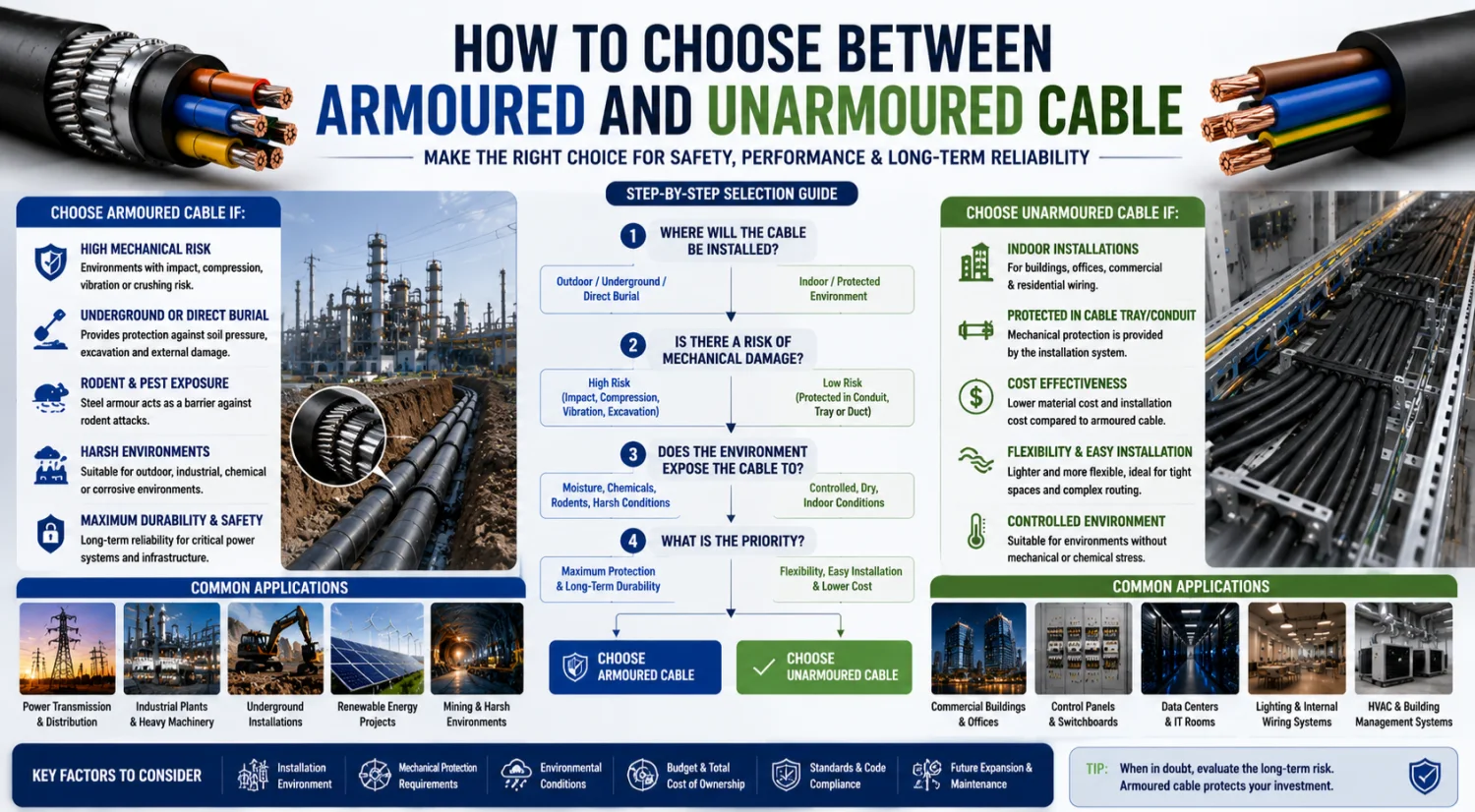
Selecting the correct cable depends on installation conditions, safety requirements, and long-term operational risk.
Table: Key Selection Factors for Armoured and Unarmoured Cable
|
Selection Factor |
Engineering Consideration |
Recommended Cable Type |
|
Underground Installation |
Soil pressure and excavation risk |
Armoured cable |
|
Indoor Cable Tray Installation |
Controlled environment |
Unarmoured cable |
|
Mechanical Impact Risk |
Heavy equipment or vibration exposure |
Armoured cable |
|
Installation Flexibility |
Tight routing and confined spaces |
Unarmoured cable |
|
Moisture and Corrosion Exposure |
Outdoor environmental conditions |
Armoured XLPE cable |
|
Telecommunications Protection |
EMI and rodent resistance |
Armoured fiber or Cat6 cable |
|
Budget Constraints |
Initial installation cost |
Unarmoured cable |
|
Long-Term Durability |
Harsh industrial operating conditions |
Armoured cable |
|
Weight Restrictions |
Cable tray structural loading |
Unarmoured cable |
|
Regulatory Compliance |
IEC and UL standards |
Depends on application |
Evaluate Mechanical Risk
High-risk environments generally require armoured cable protection.
Analyze Installation Method
Direct burial and outdoor installations typically favor armored cable systems.
Indoor conduit installations may use unarmoured cable.
Consider Environmental Conditions
Engineers should evaluate:
- Moisture exposure
- UV radiation
- Corrosion risk
- Chemical exposure
- Temperature variation
Review Budget Constraints
The price difference between armoured and unarmoured cable may influence project economics.
However, lower initial cost should not compromise long-term reliability.
Verify Regulatory Standards
Cable systems must comply with:
- IEC standards
- UL standards
- IEEE requirements
- Local electrical codes
8. Future Trends in Cable Protection Technology
Modern cable technology continues evolving rapidly.
Advanced XLPE Insulation Systems
Next-generation XLPE power cable systems offer:
- Higher thermal capacity
- Lower dielectric loss
- Improved aging resistance
Lightweight Armoring Materials
Manufacturers increasingly develop:
- Aluminum armor systems
- Composite armoring
- Flexible metallic protection
to reduce installation difficulty.
Smart Cable Monitoring
Future armoured electrical cable systems may integrate:
- Thermal monitoring
- Fault detection
- Predictive maintenance sensors
Renewable Energy Expansion
Global renewable infrastructure growth continues to increase demand for durable underground armoured power cable systems.
Data Center Infrastructure Growth
The expansion of AI data centers and telecommunications networks drives demand for both armoured fiber cable and high-performance unarmoured data cables.
FAQ: Armoured Cable and Unarmoured Cable
1: What is the main difference between armoured cable and unarmoured cable?
The main difference is mechanical protection. Armoured cable includes a metallic protective layer, usually steel wire or steel tape, which protects the cable from impact, compression, and environmental damage. Unarmoured cable does not include this armor layer and is mainly used in protected indoor installations.
2: Where is armoured cable commonly used?
Armoured cable is commonly used in:
- Underground power distribution
- Industrial facilities
- Outdoor installations
- Renewable energy projects
- Utility substations
- Mining and heavy industrial environments
Its strong mechanical protection makes it suitable for harsh operating conditions.
3: What are the advantages of XLPE armoured power cable?
Armoured XLPE cable offers several advantages, including:
- High thermal resistance
- Excellent electrical insulation
- Long service life
- Moisture resistance
- Strong mechanical protection
- Suitable for medium and high voltage systems
These features make XLPE power cable widely used in modern electrical infrastructure.
4: Is an unarmoured cable suitable for outdoor installation?
Unarmoured cable can be used outdoors if additional protection, such as conduit systems or cable trays, is provided. However, for direct burial or environments with high mechanical risk, armoured electrical cable is generally recommended.
5: Why is armoured cable more expensive than unarmoured cable?
The price difference between armoured and unarmoured cable is mainly due to:
- Additional metallic armor materials
- More complex manufacturing processes
- Higher transportation weight
- Increased installation requirements
However, armoured cable may reduce long-term maintenance and replacement costs in demanding environments.
6: What is the difference between armoured XLPE cable and unarmoured XLPE cable?
Armoured XLPE cable includes metallic protection layers for mechanical durability, while unarmoured XLPE cable does not. Both use XLPE insulation, but armoured versions are designed for underground, industrial, and outdoor applications where higher physical protection is required.
Conclusion
Armoured and unarmoured cables each serve critical roles within modern electrical infrastructure. Armoured cable systems provide superior mechanical protection, durability, and underground installation capability, making them ideal for harsh industrial and outdoor environments. Unarmoured cables, meanwhile, offer lower cost, improved flexibility, and easier installation for protected indoor systems.
Choosing between armoured and unarmoured cable requires careful evaluation of environmental conditions, installation methods, safety requirements, mechanical risks, and long-term operational reliability. As renewable energy systems, industrial automation, and smart infrastructure continue expanding globally, both cable technologies will remain essential components of modern electrical engineering and power distribution systems.

Related Articles
Related Products
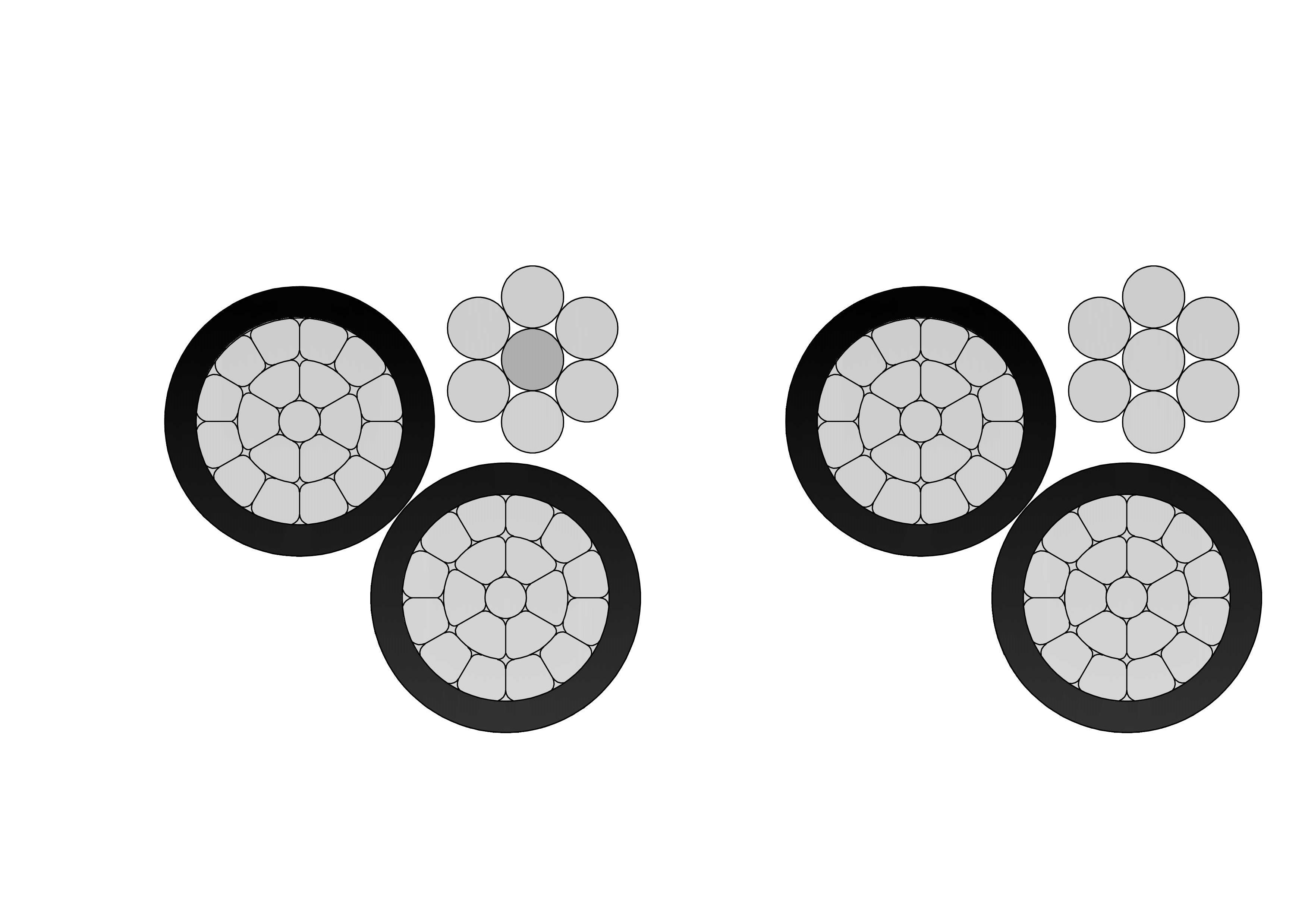
3/0 Melita Aluminum Conductor Triplex Overhead Service Drop Cable
The 3/0-3/0-3/0 Melita Aluminum Conductor Triplex Overhead Service Drop Cable is designed for high-performance overhead power distribution from utility poles to residential, commercial, or light industrial weatherheads. It features concentric-lay-stranded 1350-H19 aluminum conductors (#3/0 AWG, 19-strand), black cross-linked polyethylene (XLPE) insulation for exceptional weather, UV, and thermal resistance, and a bare neutral messenger (#3/0 AWG, typically ACSR or AAC). Rated for 600 volts phase-to-phase at conductor temperatures up to 90°C (XLPE) or 75°C (Poly), it supports an allowable ampacity of approximately 275 amps (XLP). Compliant with ASTM B-230, B-231, B-232, B-399, and ICEA S-76-474 standards, this robust yet lightweight cable ensures easy installation, excellent conductivity, and long-term durability in challenging outdoor conditions like wind, ice, moisture, and temperature extremes.
336 Limpet Aluminum Conductor Triplex Overhead Service Drop Cable
The 336 Limpet Triplex Aluminum Overhead Service Drop Cable is specifically designed for reliable and efficient power distribution from utility poles to residential, commercial, and light industrial service entrances. This cable features two insulated aluminum phase conductors and a bare ACSR (Aluminum Conductor Steel Reinforced) messenger, which serves as both the neutral conductor and the primary mechanical support for the cable. The conductors are insulated with black cross-linked polyethylene (XLP), delivering exceptional UV resistance, moisture protection, and long-term outdoor durability. Rated 600V phase-to-phase with conductor temperatures up to 90°C (XLPE), it supports ampacity ratings around 395–445A (depending on conditions). Compliant with ASTM B-230, B-231, B-232, and ICEA S-76-474 standards, the 336 Limpet offers lightweight, corrosion-resistant construction ideal for demanding secondary distribution and large-scale service drops.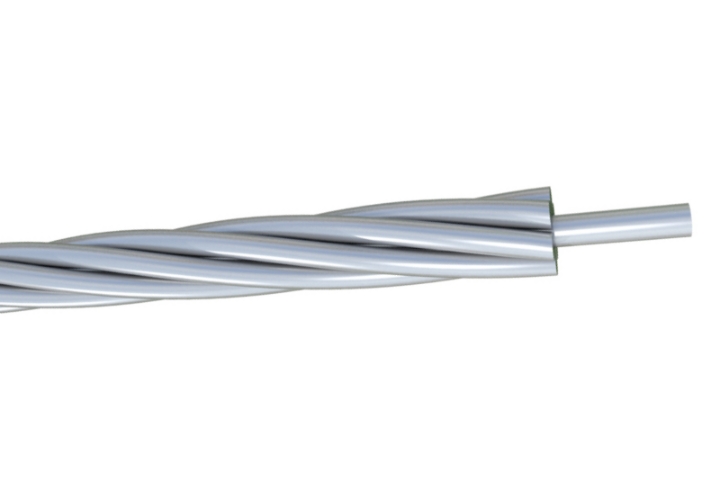
6 Gauge Galvanized Steel Conductor Wire
The 6 Gauge Galvanized Steel Conductor Wire is a premium high-strength bare steel wire designed for overhead power line applications. Manufactured with heavy hot-dip zinc coating, this 6 AWG galvanized conductor provides exceptional corrosion resistance and long service life in harsh outdoor environments. It offers high tensile strength and reliable mechanical performance, making it ideal for use as overhead ground wire (static wire), guy wire, or messenger wire. Compliant with ASTM A475 and related standards, the 6 Gauge Galvanized Steel Conductor Wire undergoes rigorous testing from raw materials to finished product to ensure consistent quality, uniform zinc adhesion, and superior breaking strength. Its durable construction minimizes maintenance while delivering dependable protection and support for transmission and distribution lines.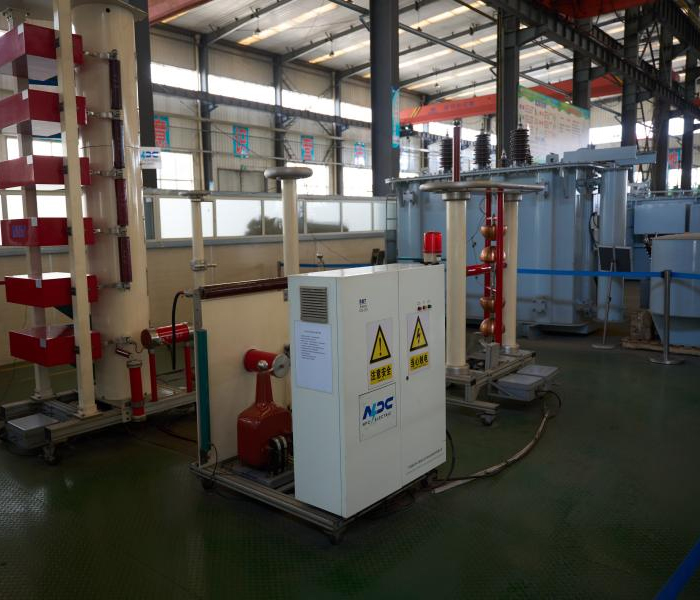
2000kVA Dry Type Transformer
The NPC ELECTRIC 2000kVA Dry Type Transformer is a robust and efficient power solution designed to handle the electrical needs of large-scale industrial and commercial operations. With a capacity of 2000kVA, it features advanced dry-type insulation, ensuring enhanced safety, minimal maintenance, and long-lasting performance. This transformer is built to operate reliably in various environmental conditions while offering low noise levels and a reduced environmental footprint. It achieves efficiencies around 99.47–99.48% at 35% load (aligned with DOE 2029 levels for three-phase low-voltage dry-type in the 1000–2500 kVA range, interpolated from published tables showing progressive gains), supports substantial harmonics, overload capability, and provides durable, eco-friendly performance with minimized lifecycle costs.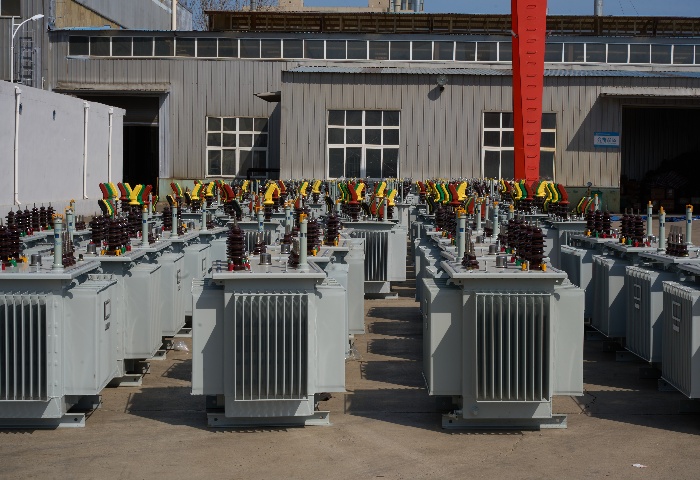
5000kVA Oil Immersed Substation Transformer
The 5000kVA Oil Immersed Substation Transformer is engineered for high-capacity power substations that demand continuous stability, strong load adaptability, and long operational life. Featuring an advanced oil-immersed insulation system, the transformer effectively enhances dielectric strength and thermal conductivity, ensuring reliable performance under heavy and fluctuating load conditions. With superior short-circuit withstand capability and efficient cooling performance, the transformer provides dependable power conversion for substations serving industrial, commercial, and infrastructure applications.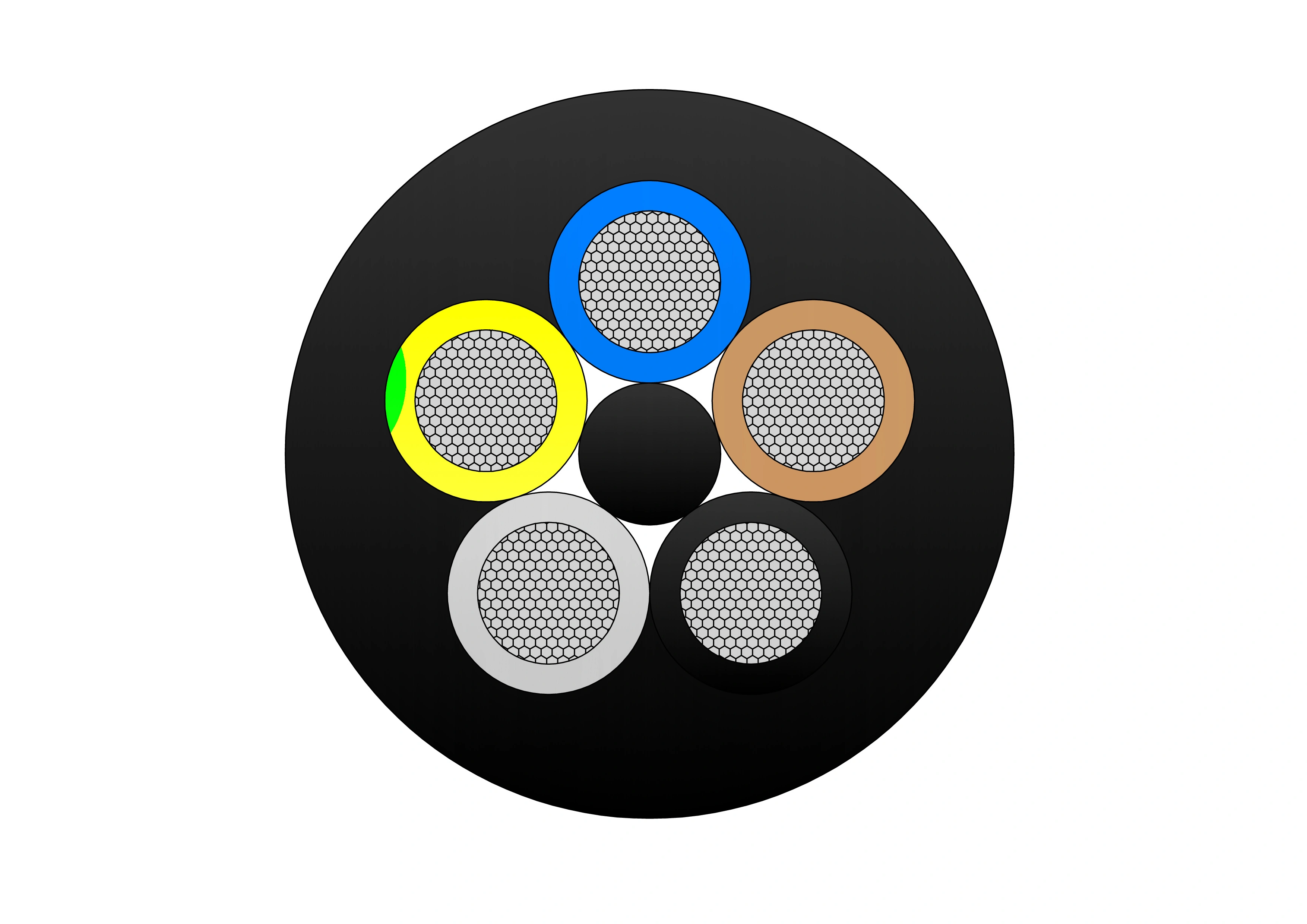
NTSCGECEWOU 3.6/6kV, 6/10kV, 8.7/15kV and 12/20kV Cable
The NTSCGECEWOU 3.6/6kV, 6/10kV, 8.7/15kV and 12/20kV Cable is a flexible, heavy-duty medium-voltage trailing/reeling cable designed for demanding mining and tunnelling operations. It features class 5 finely stranded tinned copper phase conductors for superior flexibility and corrosion resistance, semi-conductive conductor and insulation screens for field control, EPR (ethylene propylene rubber) insulation providing high dielectric strength and 90°C continuous operation, individual copper wire screens serving as earth conductors, control conductors, a monitoring conductor (ÜL), and a robust rubber outer sheath resistant to oil, flame, abrasion, tearing, and mechanical stress. Compliant with DIN VDE 0250, it supports high tensile loads, fast reeling speeds, tight bending radii, and effective EMC shielding across voltage ranges. The NTSCGECEWOU ensures safe, reliable MV power supply to mobile equipment such as shearers, tunnel boring machines, and conveyors in harsh underground and opencast environments, minimising downtime and enhancing operational efficiency.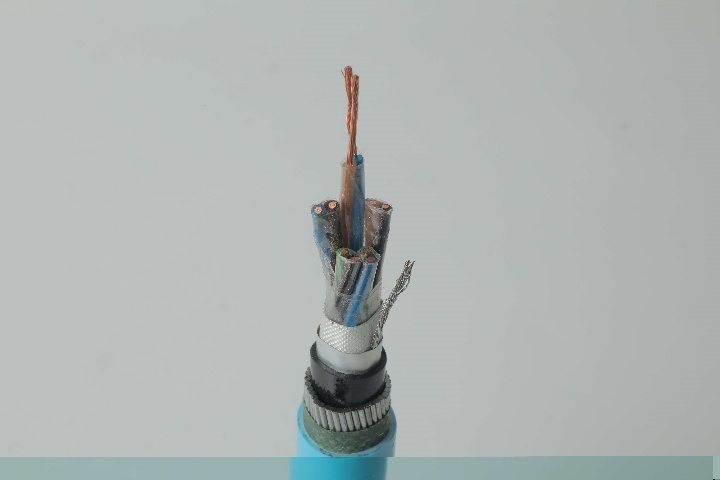
Instrumentation Cables—PVC Insulated, Overall Screened, Unarmoured PVC Sheathed Cables (CU/PVC/OSCR/PVC)
Instrumentation Cables CU/PVC/OSCR/PVC are PVC Insulated, Overall Screened, Unarmoured PVC Sheathed Cables. They are multi-conductor cables that carry and transport low-voltage electrical signals. These low-voltage signals are used to control and monitor electrical power systems. Instrumentation cables have many different industrial applications that include broadcasting, equipment control, such as drilling and pumping in the oil and gas industry, and data transfer, which includes analog and digital signals. They are manufactured according to the BS EN 50288-7 and BS EN 50288-1 standards to ensure quality. Depending on the application, instrumentation cables can be insulated with PVC or XLPE; the cables can be armoured or unarmoured. The sheathing materials can be of PVC, LSZH, or PE. The cables can have additional flame retardant or flame retardant properties, and they can be manufactured with special protections such as lead sheaths, or DRYLAM or AIRBAG technology.
167kVA Single Phase Pad Mounted Transformer
The 167kVA single phase pad mounted transformer is engineered for higher-capacity underground residential and light commercial distribution, efficiently transforming primary voltages such as 12470GrdY/7200, 24940GrdY/14400, 34500GrdY/19920, or dual-voltage configurations to secondary 120/240V split-phase or 240V outputs. Constructed with premium grain-oriented silicon steel cores and aluminum or copper windings, it delivers exceptional energy efficiency and minimal losses while fully complying with DOE 2016 standards and IEEE/ANSI C57.12.34 specifications.
6 Paludina Aluminum Conductor Triplex Overhead Service Drop Cable
The 6 Paludina Aluminum Conductor Triplex Overhead Service Drop Cable is engineered for safe and efficient overhead service drop installations. It features two insulated aluminum phase conductors twisted around a reinforced neutral messenger, delivering balanced electrical performance and strong mechanical support. This cable offers lightweight construction, corrosion resistance, and excellent weatherability. The insulation system of the 6 Paludina Aluminum Conductor Triplex Overhead Service Drop Cable provides long-term protection against sunlight, moisture, and temperature fluctuations, reducing maintenance costs and extending service life. A complete quality assurance system governs the manufacturing process, integrating raw material testing, process inspection, and finished product testing. Each production stage follows strict control procedures to ensure consistent compliance with international standards and utility specifications. The 6 Paludina Aluminum Conductor Triplex Overhead Service Drop Cable is a dependable choice for modern overhead power distribution networks.
250MVA 330kV High-Voltage Oil-Immersed Distribution Transformer for Grid & Substation
The 250MVA 330kV High-Voltage Oil-Immersed Distribution Transformer is engineered for reliable and efficient power transmission in large utility grids and high-demand substations. Designed with advanced insulation and a durable oil-immersed cooling system, it ensures excellent thermal stability and long service life. The high-voltage 330kV configuration provides exceptional performance in long-distance power delivery, minimizing losses and improving grid stability. Its precision-wound copper coils, high-strength core materials, and robust tank structure guarantee safe operation under fluctuating load conditions. With strong short-circuit resistance, high dielectric strength, and low noise operation, this transformer meets stringent international standards. It is widely used in national grid projects, power plants, and heavy-industry energy networks, supporting continuous, stable, and efficient power distribution.
(N)TSCGECEWOU 3.6/6kV and 6/10kV ATB Cable
The (N)TSCGECEWOU 3.6/6kV and 6/10kV ATB Cable is a flexible, heavy-duty medium-voltage trailing/reeling cable with anti-torsion braid (ATB) for superior torsional stability in extreme mining conditions. It features class 5 finely stranded tinned copper phase conductors for flexibility and corrosion resistance, semi-conductive conductor and insulation screens, EPR insulation for high dielectric strength and 90°C rating, copper wire braid screen for EMI/grounding, control conductors, monitoring conductor (ÜL), anti-torsion polyester braid for reduced twisting under dynamic loads, and a tough rubber outer sheath resistant to oil, flame, abrasion, and mechanical stress. Compliant with DIN VDE 0250, it handles high tensile forces, fast reeling, and tight bends while providing EMC protection. The (N)TSCGECEWOU ATB ensures safe, reliable MV power to mobile equipment like draglines, shovels, and tunnel boring machines in harsh opencast/underground environments.2Y-high-voltage-power-cable-2.webp)
A2XS(FL)2Y MDPE High Voltage 64/110 (123) kV Power Cable
The A2XS(FL)2Y MDPE High Voltage 64/110 (123) kV Cable is a single-core aluminum conductor cable with XLPE insulation and an MDPE sheath, designed for extra-high voltage power transmission. Built according to IEC 60840 and IEC 62067 standards, it ensures superior electrical performance, mechanical protection, and water resistance. Suitable for underground, underwater, outdoor, indoor, and duct installations, it features water-blocking tape to prevent water propagation inside, ensuring long-term reliability in power stations, industrial plants, and distribution networks. Compliant with IEC 60840, VDE 0276-620, or equivalent standards, it offers high ampacity, superior water tree resistance, and extended service life even in wet, direct-buried, or aggressive soil conditions. The A2XS(FL)2Y MDPE is ideal for major UHV transmission grids, underground/submarine lines, river crossings, offshore wind connections, and large-scale renewable energy projects where water ingress protection, efficiency, and ultra-reliability are essential.SSCHOU-mining-cable-2.webp)
(N)SSCHOU-J 0.6/1kV Mining Cable
The (N)SSCHOU-J 0.6/1kV cable is a flexible, rubber-insulated low voltage power cable designed in accordance with VDE 0250 standards. It is engineered for underground mining, tunneling, and heavy-duty industrial applications where flame retardancy, oil resistance, EMC protection, and mechanical durability are critical. With tinned copper conductors, robust rubber insulation, and a tinned copper wire braid (TCWB) screen for electromagnetic compatibility, this cable offers high electrical safety and mechanical reliability. It is suitable for dry, damp, wet, and hazardous environments, both indoors and outdoors, and can be permanently submerged in water up to 100 meters. Ideal for frequency converter drives and installations requiring superior shielding and long service life.
TW AND THW
Electrical wire TW AND THW is used in new construction projects or rewiring tasks in 600-volt systems. It is from NPC Electric are designed for building wiring applications where dependable electrical performance and installation safety are required. These single-core copper conductors are insulated with high-quality thermoplastic materials, providing stable conductivity, good mechanical protection, and resistance to heat and moisture. TW wire is suitable for dry or damp locations with moderate temperature ratings, while TH wire offers higher heat resistance for applications requiring enhanced thermal performance. Manufactured under strict quality control, NPC Electric TW and TH Wires deliver uniform insulation thickness, consistent conductor structure, and long service life. Their reliable performance and ease of handling make them a trusted choice for residential, commercial, and light industrial electrical installations.
350kVA Epoxy Resin Cast Dry Type Transformer 3 Phase 6.6kV/0.4kV Low Noise
Presenting the high-performance 350kVA Epoxy Resin Cast Dry Type Transformer 3 Phase 6.6kV/0.4kV Low Noise, a cutting-edge, eco-friendly power distribution solution ideal for indoor applications demanding superior safety and quiet operation. This three-phase dry-type transformer utilizes premium epoxy resin vacuum casting on high-conductivity copper windings and low-loss grain-oriented silicon steel cores, achieving outstanding energy efficiency (typically 98%+), minimal no-load/load losses, and exceptional partial discharge suppression (<10pC). With natural air (AN) cooling, Class F/H insulation, fire-retardant self-extinguishing properties, and robust short-circuit withstand, it offers maintenance-free reliability in harsh or sensitive environments. Fully compliant with IEC 60076-11, this compact unit steps down 6.6kV primary (with ±2×2.5% off-circuit taps) to 0.4kV secondary (Dyn11 vector group), supporting sustainable grids with overload capability and zero oil risks.Welcome your inquiry
Honesty, Integrity, Frugality, Activeness and Passion