Overhead Power Lines: What They Are, How They Work, and Why They Matter
2026-05-21
Overhead power lines are one of the most visible and essential components of modern electrical infrastructure. From rural utility poles to ultra-high-voltage transmission corridors crossing entire countries, overhead lines play a central role in transmitting electrical power from generation stations to homes, commercial buildings, industrial facilities, and renewable energy systems.
Despite rapid developments in underground cable systems, overhead power lines remain the dominant technology for electrical transmission and distribution worldwide due to their:
- Lower installation cost
- Easier maintenance access
- High transmission efficiency
- Scalability over long distances
Modern overhead power systems are far more advanced than traditional bare conductor networks. Today’s infrastructure includes:
- High voltage transmission lines
- Smart grid integration
- Overhead insulated cable systems
- Weather-resistant conductor materials
- Advanced power line monitoring technologies
At the same time, public concerns continue regarding:
- Living near overhead power lines
- Safe distance to live from overhead power lines
- Wildlife interaction
- Storm damage
- Electrical safety risks
Understanding how overhead power lines work, how they are designed, and why they matter is therefore essential for utilities, engineers, infrastructure planners, and the general public.
1. What Are Overhead Power Lines?
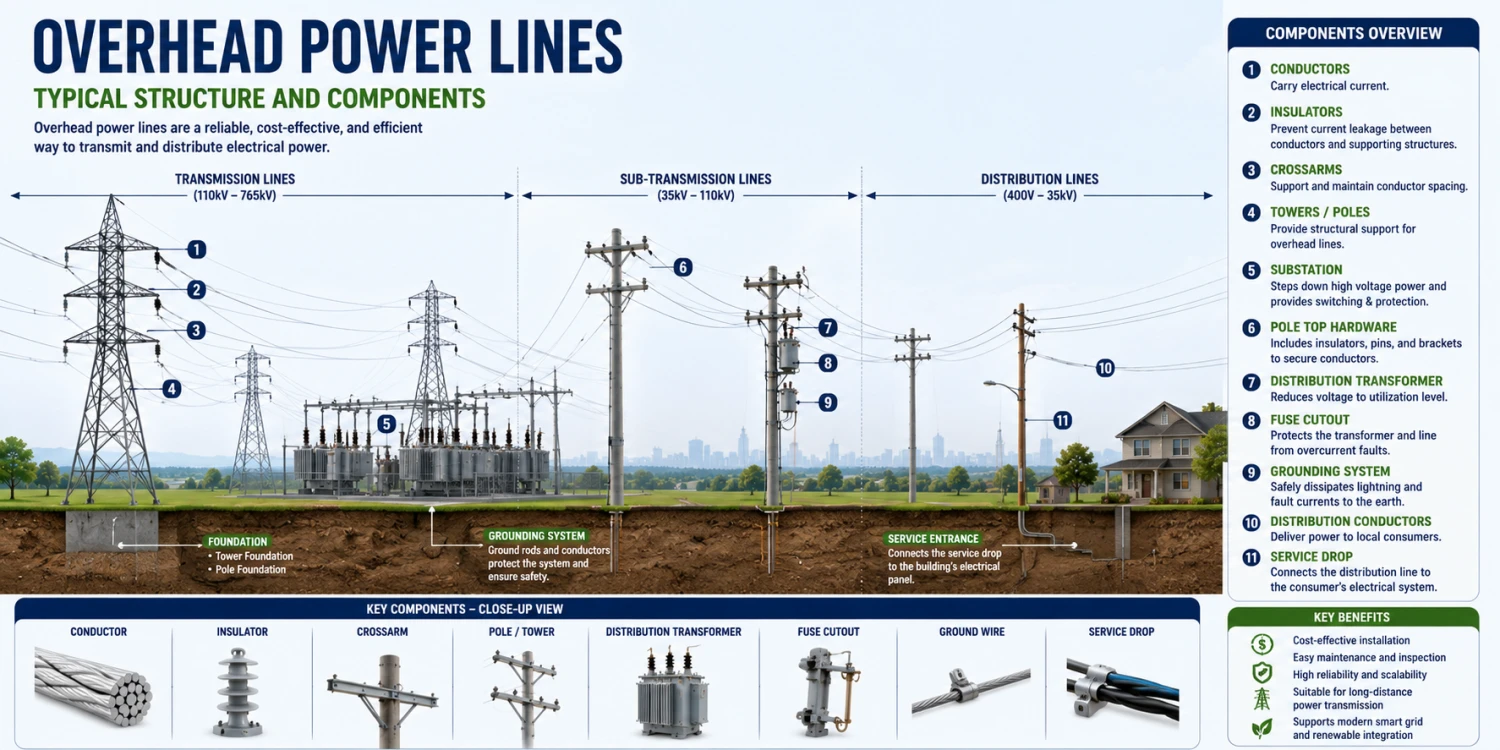
Overhead power lines are electrical conductors suspended above ground using utility poles or transmission towers to transport electrical power over short or long distances.
These systems form the backbone of national electrical distribution and transmission networks.
Main Components of Overhead Power Systems
A typical overhead power line system includes:
- Conductors
- Insulators
- Utility poles or towers
- Crossarms
- Grounding systems
- Transformers
- Switchgear
- Protective electrical equipment
Each component is engineered to ensure safe and reliable power transmission.
Main Components of an Overhead Power Line System
|
Component |
Main Function |
Typical Materials |
|
Conductors |
Transfer electrical power |
Aluminum, copper, ACSR |
|
Utility Pole / Tower |
Support overhead lines |
Steel, concrete, wood |
|
Insulators |
Prevent electrical leakage |
Porcelain, polymer, glass |
|
Crossarms |
Support conductor spacing |
Steel or composite materials |
|
Ground Wire |
Lightning protection |
Galvanized steel |
|
Transformers |
Voltage transformation |
|
|
Switchgear |
System protection and control |
Metal enclosed equipment |
|
Overhead Power Line Signs |
Safety warning and hazard indication |
Reflective metal or polymer |
Difference Between Transmission and Distribution Lines
Transmission lines transport bulk electrical power over long distances using high-voltage lines.
Distribution lines reduce voltage and deliver electricity to local consumers.
Typical voltage ranges include:
|
System Type |
Typical Voltage |
|
Distribution Lines |
400 V – 35 kV |
|
Sub-Transmission Lines |
35 kV – 110 kV |
|
High Voltage Transmission |
110 kV – 765 kV+ |
2. How Overhead Power Lines Work
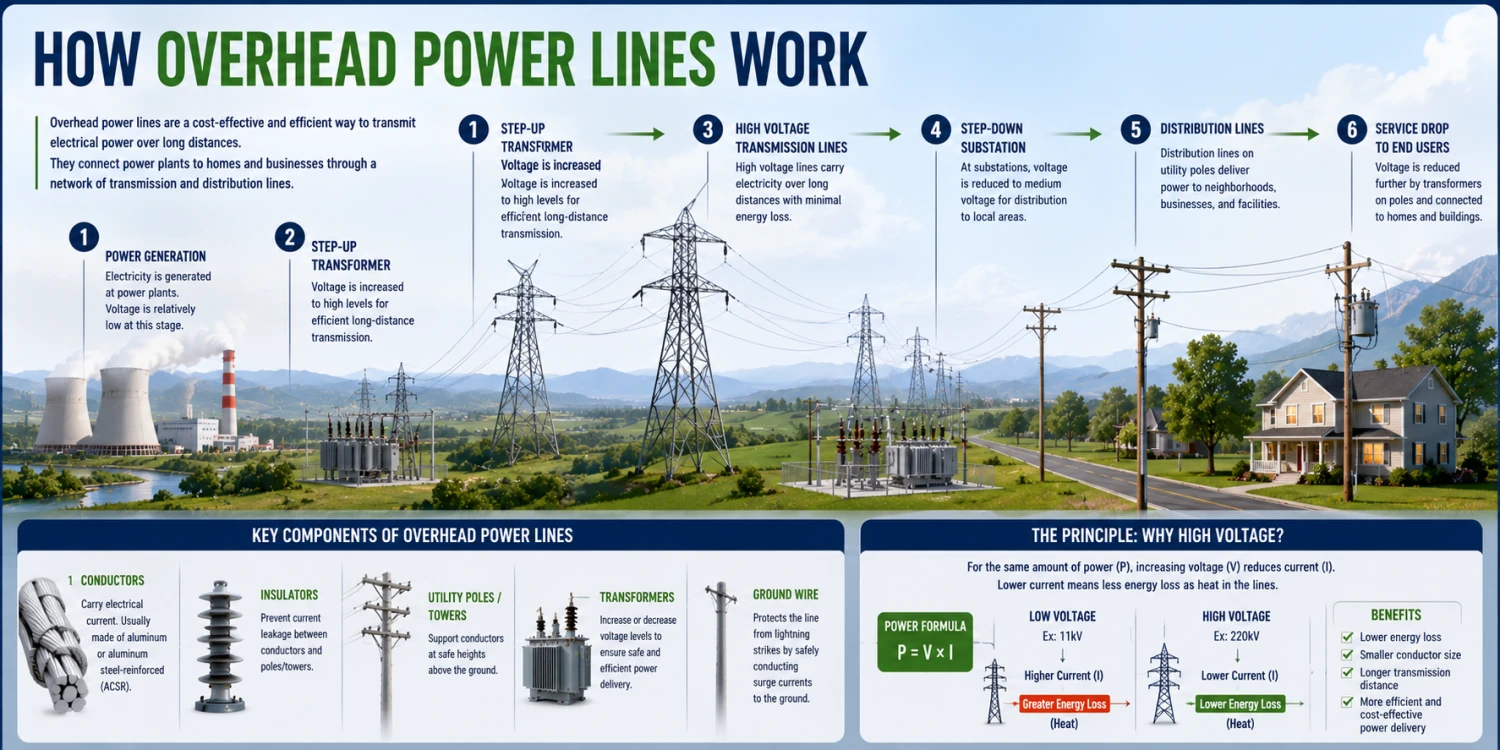
Overhead lines transmit electrical energy using conductive materials such as aluminum or copper conductors.
Electric current flows through the conductors while the surrounding air acts as insulation.
Why High Voltage Is Used
Electrical power transmission becomes more efficient at higher voltage.
Higher voltage reduces current for the same power level, minimizing:
- Energy loss
- Heat generation
- Conductor size requirements
This principle is fundamental to long-distance electrical power transmission.
Role of Transformers
Transformers increase or decrease voltage levels throughout the power system.
- Step-up transformers increase voltage for transmission
- Step-down transformers reduce voltage for distribution
Without transformers, modern overhead power systems would not be practical.
Alternating Current Transmission
Most overhead lines use alternating current (AC) systems because AC voltage can be transformed efficiently using transformers.
However, some ultra-long-distance systems now use HVDC technology.
3. Types of Overhead Power Lines
Different applications require different overhead line configurations.
Table: Comparison of Main Overhead Power Line Types
|
Overhead Line Type |
Conductor Structure |
Typical Voltage Range |
Main Applications |
Key Advantages |
|
Bare Conductor Overhead Line |
Uninsulated conductor |
400 V – 765 kV |
Utility transmission and distribution |
Low installation cost |
|
Overhead Insulated Cable |
Insulated conductor |
1 kV – 35 kV |
Urban and forest distribution networks |
Improved public safety |
|
High Voltage Transmission Line |
Large tower-mounted conductors |
110 kV – 765 kV+ |
Long-distance transmission |
High power transfer capability |
|
Compact Overhead Distribution Line |
Reduced spacing in the insulated system |
400 V – 35 kV |
Dense urban environments |
Space-saving installation |
|
ACSR Overhead Line |
Aluminum conductor steel reinforced |
11 kV – 500 kV |
Utility transmission networks |
High tensile strength |
|
HTLS Transmission Line |
High temperature, low sag conductor |
110 kV – 765 kV |
Smart grid upgrades |
Increased transmission capacity |
Bare Conductor Overhead Lines
Traditional overhead systems use uninsulated conductors suspended on insulators.
Advantages include:
- Low cost
- Excellent cooling
- Simple installation
Overhead Insulated Cable
Overhead Insulated Cable systems use insulated conductors to improve safety and reduce outage risks.
These systems are increasingly used in:
- Urban environments
- Forest regions
- Storm-prone areas
Advantages include:
- Reduced accidental contact
- Improved reliability
- Lower vegetation fault risk
High Voltage Transmission Lines
High-voltage lines carry bulk electrical power between substations and regional grids.
These systems require:
- Large transmission towers
- Wide clearance distances
- Advanced insulation coordination
Compact Distribution Lines
Compact overhead distribution systems reduce right-of-way requirements in densely populated urban areas.
4. Power Line Design and Engineering Considerations
Modern power line design requires balancing electrical, mechanical, environmental, and economic factors.
Conductor Selection
Engineers select conductors based on:
- Current carrying capacity
- Mechanical strength
- Corrosion resistance
- Weight
- Thermal performance
Aluminum conductor steel reinforced (ACSR) conductors are widely used.
Utility Pole and Tower Design
Utility poles may be constructed from:
- Wood
- Steel
- Concrete
- Composite materials
Transmission towers are engineered for:
- Wind loading
- Ice loading
- Mechanical tension
- Lightning protection
Insulation and Clearance
Power lines overhead require safe electrical clearances from:
- Buildings
- Roads
- Vegetation
- Other infrastructure
Insulator systems prevent leakage current and flashover.
Weather Resistance
Overhead systems must withstand:
- Lightning
- Windstorms
- Ice accumulation
- Extreme temperatures
- Salt corrosion
5. Safety Around Overhead Power Lines
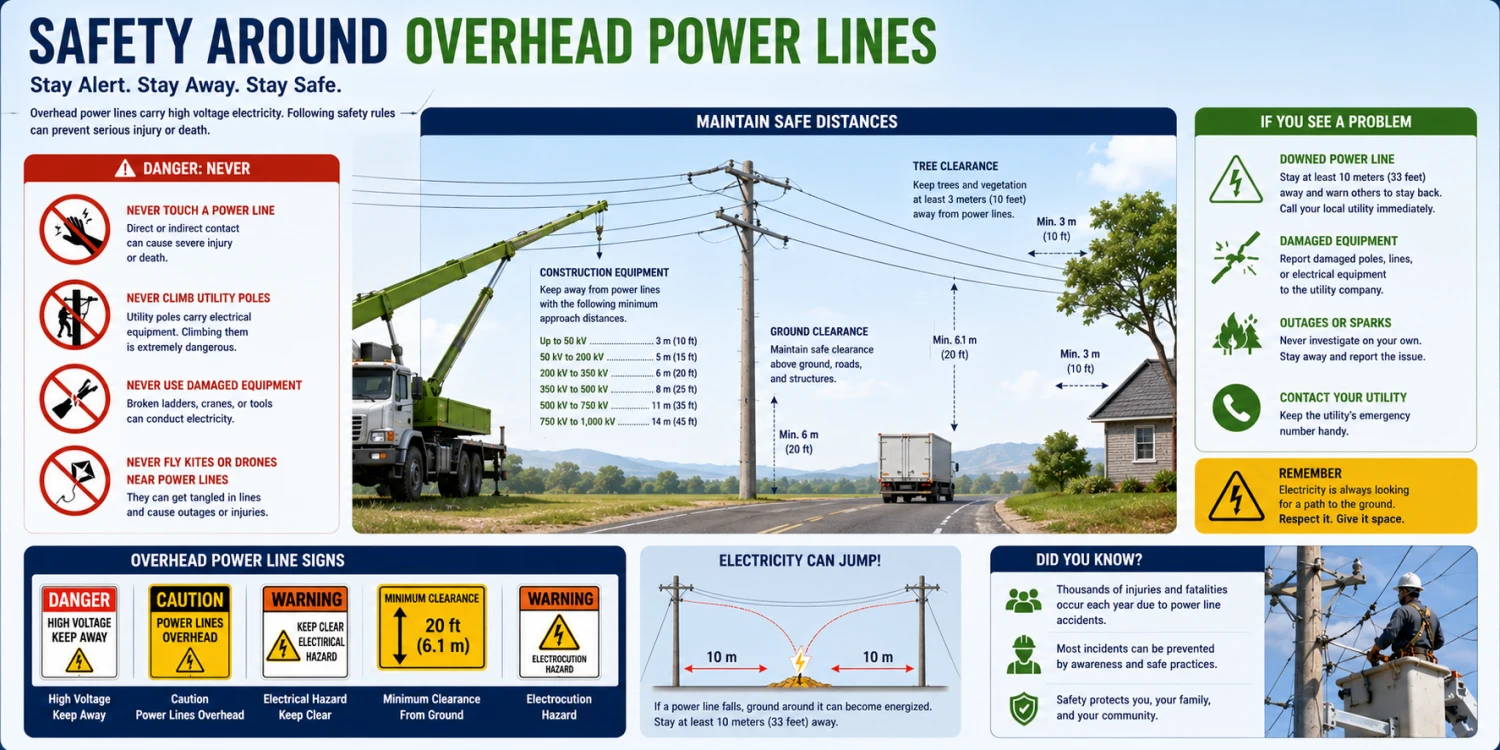
Electrical safety is one of the most important aspects of overhead power systems.
Table: Overhead Power Line Safety and Clearance Recommendations
|
Situation |
Recommended Safety Practice |
Potential Risk |
|
Living Near Overhead Power Lines |
Follow local EMF and zoning regulations |
Public safety concern |
|
Construction Near Power Lines |
Maintain minimum approach distance |
Electrical arc hazard |
|
Tree Contact with Conductors |
Routine vegetation trimming |
Outages and wildfire risk |
|
Crane or Ladder Operation |
Avoid overhead conductor proximity |
Electrocution risk |
|
Storm Damage Inspection |
Stay away from fallen lines |
Energized conductor danger |
|
Touching a Power Line |
Never touch directly or indirectly |
Severe injury or death |
|
Animal Contact with Power Systems |
Install wildlife protection devices |
Electrical faults and outages |
Why Touching Power Lines Is Dangerous
Touching energized conductors may cause:
- Severe electric shock
- Arc flash injuries
- Fatal electrocution
Even indirect contact through conductive objects can be dangerous.
People should never touch a power line under any circumstances.
Overhead Power Line Signs
Overhead power line signs warn the public and construction workers about electrical hazards.
These signs are commonly installed near:
- Construction sites
- High voltage corridors
- Railway systems
- Industrial facilities
Safe Distance to Live from Overhead Power Lines
Many people ask about the safe distance to live from overhead power lines.
Safety regulations vary by country and voltage level. Modern transmission systems are designed to operate within international electromagnetic field (EMF) safety guidelines.
Local regulations typically establish:
- Minimum building clearance
- Transmission corridor width
- Public safety zones
Construction Equipment Risks
Construction cranes, ladders, and agricultural machinery can accidentally contact overhead power lines.
Utilities, therefore, establish a strict minimum approach distance.
6. Environmental and Wildlife Considerations
Overhead transmission systems interact directly with the environment.
Birds and Wildlife
Birds and animals interact with overhead lines in multiple ways.
Utilities now implement:
- Bird diverters
- Insulated hardware
- Wildlife protection systems
to reduce electrical accidents and protect biodiversity.
Vegetation Management
Trees contacting overhead conductors can cause outages and wildfires.
Routine vegetation management is therefore critical.
Visual and Land Use Impact
Large transmission corridors may affect:
- Property development
- Scenic landscapes
- Land utilization planning
Modern compact tower designs help reduce environmental impact.
7. Advantages and Challenges of Overhead Power Lines
Major Advantages
Overhead power systems offer:
- Lower installation cost
- Easier maintenance access
- Faster fault repair
- Efficient long-distance transmission
- Scalable infrastructure expansion
These advantages explain why overhead systems dominate global transmission networks.
Main Challenges
However, overhead lines also face challenges such as:
- Storm vulnerability
- Lightning exposure
- Visual impact
- Wildlife interaction
- Vegetation management costs
Overhead vs Underground Power Cables
Underground power cables offer:
- Better visual appearance
- Improved weather protection
But they also involve:
- Higher installation cost
- More difficult maintenance
- Thermal limitations
As a result, many utilities combine both systems.
Table: Overhead vs Underground Power Systems
|
Parameter |
Overhead Power Lines |
Underground Power Cables |
|
Installation Cost |
Lower |
Higher |
|
Maintenance Accessibility |
Easier |
More difficult |
|
Weather Exposure |
High |
Low |
|
Fault Detection |
Faster |
More complex |
|
Visual Impact |
Higher |
Minimal |
|
Transmission Cooling |
Natural air cooling |
Limited thermal dissipation |
|
Installation Speed |
Faster |
Slower |
|
Urban Suitability |
Moderate |
Excellent |
8. Future Trends in Overhead Power Infrastructure
Modern overhead power systems continue evolving rapidly.
Smart Grid Integration
Smart overhead networks are increasingly used:
- Real-time sensors
- AI monitoring systems
- Automated fault detection
- Predictive maintenance
Advanced Conductors
New conductor technologies improve:
- Current capacity
- Thermal resistance
- Transmission efficiency
Examples include:
- HTLS conductors
- Composite core conductors
Renewable Energy Integration
Renewable energy expansion requires major transmission upgrades to connect:
- Offshore wind farms
- Utility-scale solar plants
- Remote hydroelectric facilities
to population centers.
More Resilient Infrastructure
Utilities are investing in:
- Storm-resistant towers
- Fire-resistant designs
- Improved insulation systems
- Climate-resilient infrastructure
FAQ Questions and Answers
1. What are overhead power lines used for?
Overhead power lines are used to transmit and distribute electrical power from power plants and substations to residential, commercial, and industrial consumers. They form the backbone of modern electrical transmission infrastructure.
2. Why are high-voltage lines used for long-distance transmission?
High voltage lines reduce electrical current during transmission, which minimizes energy loss and improves transmission efficiency over long distances. This makes large-scale power transmission economically practical.
3. What is the difference between overhead insulated cable and bare conductor lines?
Bare conductor overhead lines use uninsulated conductors exposed to air, while Overhead Insulated Cable systems use insulated conductors to improve public safety, reduce vegetation faults, and enhance reliability in urban or forest environments.
4. Is it safe to live near overhead power lines?
Modern overhead power systems are designed according to international safety standards and electromagnetic field regulations. Local governments establish safe distance requirements and transmission corridor clearances to protect public safety.
5. Why should you never touch a power line?
Touching a power line can cause severe electric shock, arc flash injury, or death. Even indirect contact through ladders, tools, cranes, or wet surfaces may result in dangerous electrical current flow.
6. What are overhead power line signs used for?
Overhead power line signs warn workers and the public about electrical hazards near transmission and distribution systems. They are commonly installed near construction sites, railways, industrial zones, and high voltage corridors.
7. What are the advantages of overhead power lines compared to underground cables?
Overhead power lines generally offer lower installation costs, easier maintenance access, faster fault repair, and more efficient long-distance transmission compared to underground power cable systems.
Conclusion
Overhead power lines remain one of the most important components of global electrical infrastructure. From local utility pole distribution systems to ultra-high-voltage transmission lines, these networks enable reliable electrical power delivery across cities, industries, and renewable energy systems worldwide.
Modern overhead power infrastructure combines advanced engineering, efficient electrical transmission, safety systems, environmental protection technologies, and smart grid integration. Although challenges such as weather exposure, vegetation management, and public safety remain important considerations, overhead systems continue to offer unmatched scalability and cost efficiency for large-scale electrical transmission.
As global electricity demand, renewable energy development, and smart grid modernization continue accelerating, overhead power lines will remain essential to the future evolution of modern electrical infrastructure.

Related Articles

Related Products
Medium Voltage Switchgear
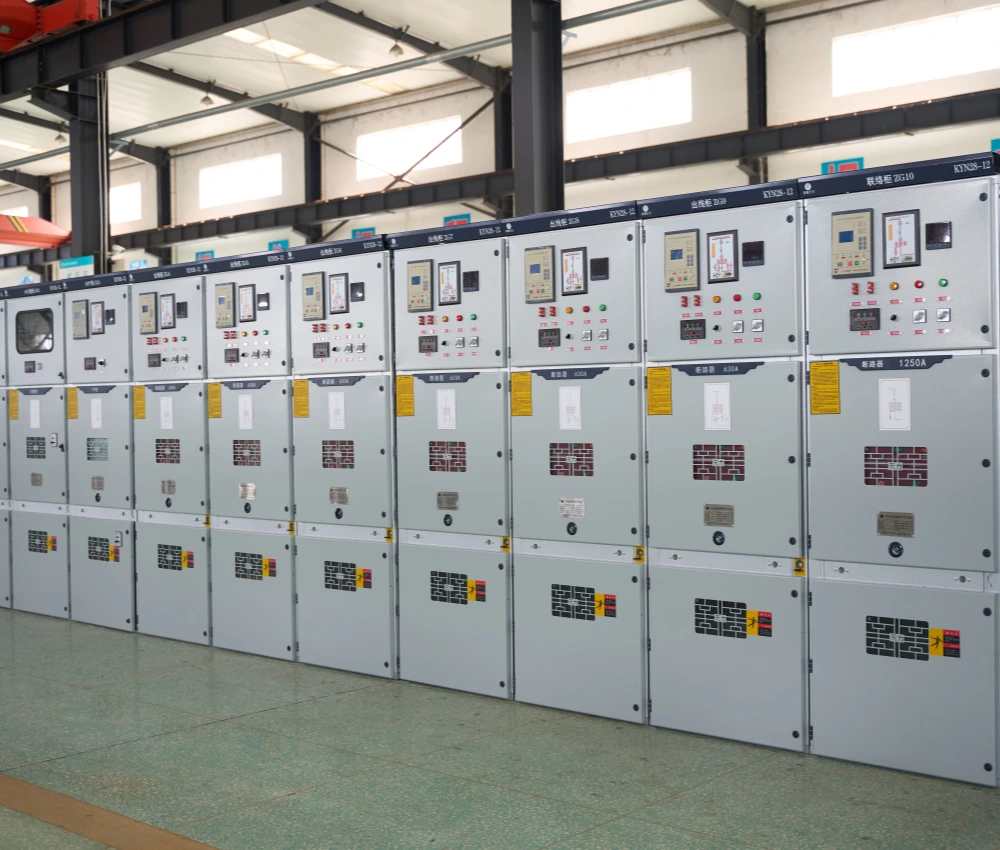
The Medium Voltage Switchgear is an advanced electrical distribution and protection system engineered for safe, reliable, and efficient medium-voltage power management in utility substations, industrial facilities, renewable energy plants, commercial infrastructure, and smart-grid applications. The system integrates vacuum circuit breakers, disconnect switches, protection relays, busbar assemblies, intelligent monitoring systems, and automation devices into a compact modular enclosure structure to ensure stable electrical distribution and enhanced operational safety. Designed with high-strength insulated structures and precision-manufactured electrical components, the medium voltage switchgear provides outstanding dielectric performance, thermal stability, and mechanical durability under demanding operating conditions. Its modular cabinet configuration improves installation flexibility, simplifies maintenance procedures, and supports future power distribution expansion while minimizing operational downtime and maintenance costs. The Medium Voltage Switchgear supports air-insulated and gas-insulated configurations, intelligent automation systems, remote communication protocols, and smart-grid integration technologies. With customizable protection schemes and scalable electrical distribution capabilities, the switchgear delivers dependable medium-voltage control and protection performance for industrial automation systems, utility power networks, renewable energy integration projects, transportation infrastructure, and mission-critical electrical facilities.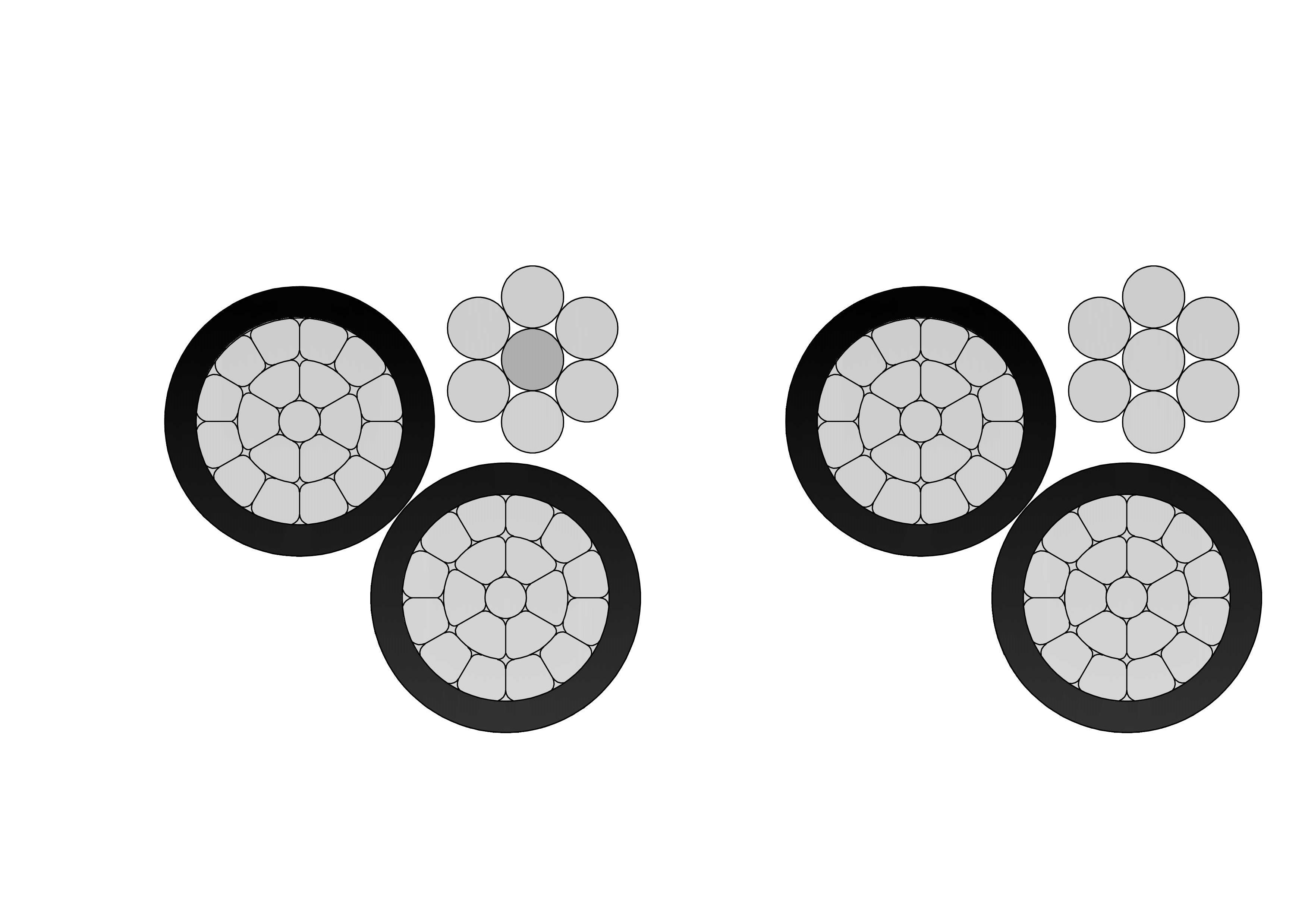
6 Minex Aluminum Conductor Triplex Overhead Service Drop Cable
The 6 Minex Aluminum Conductor Triplex Overhead Service Drop Cable is engineered for reliable overhead power distribution from utility lines to service entrances. The cable structure consists of two insulated aluminum phase conductors twisted around a reinforced neutral messenger, delivering stable electrical performance and strong mechanical support. Manufactured from high-purity aluminum and weather-resistant insulation materials, the 6 Minex Aluminum Conductor Triplex Overhead Service Drop Cable offers excellent conductivity, low weight, and ease of installation. The insulation system is designed to withstand UV radiation, moisture, temperature fluctuations, and environmental aging, ensuring dependable long-term outdoor performance. A comprehensive quality control system is applied throughout production. The 6 Minex Aluminum Conductor Triplex Overhead Service Drop Cable undergoes systematic raw material testing, continuous process inspection, and rigorous finished product testing. Each stage follows standardized procedures to ensure compliance with international standards and utility specifications. This cable is an ideal solution for residential, commercial, and light industrial overhead service drop applications requiring safety, durability, and consistent quality.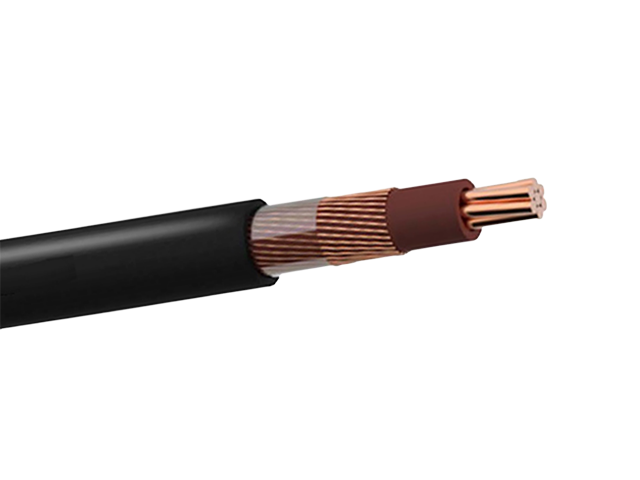
15kV Concentric Neutral Power Cable
The 15kV Concentric Neutral Power Cable is a premium medium-voltage underground distribution cable designed for reliable primary power delivery in distribution networks. It features a stranded copper or aluminum conductor, extruded semi-conducting conductor shield, TR-XLPE or EPR insulation, semi-conducting insulation shield, and helically applied bare copper concentric neutral wires, all protected by a tough sunlight-resistant LLDPE jacket. Available in 100% or 133% insulation levels with full or reduced neutral, this cable provides excellent electrical performance, moisture resistance, and mechanical protection. Suitable for direct burial or duct installations, the 15 kV Concentric Neutral Power Cable meets ICEA S-94-649, AEIC CS8, and related standards. It undergoes rigorous quality testing from raw materials to finished product, ensuring long-term reliability, low dielectric loss, and high resistance to water treeing in demanding underground environments.
FR-N20XA8E-R 12/20kV Cable Gen to NF C 33-226 - Cu/XLPE/MDPE
The FR-N20XA8E-R Triplex 12/20kV Cable is a high-performance triplex medium-voltage cable manufactured to NF C 33-226 standard for efficient and reliable power distribution. It features three stranded copper conductors (Cu) for superior conductivity, semi-conductive conductor screens, high-quality XLPE (cross-linked polyethylene) insulation for excellent dielectric strength and thermal stability (90°C continuous, 250°C short-circuit), semi-conductive insulation screens, copper wire screens for grounding and protection, and a robust medium-density polyethylene (MDPE) outer sheath providing superior mechanical protection, moisture resistance, UV stability, and chemical resistance. The triplex configuration (three cores twisted together) facilitates easy installation in overhead aerial bundled systems or underground ducts. Compliant with French NF C 33-226 and relevant IEC standards, it offers low dielectric losses, high current-carrying capacity, and long service life in demanding environments. The FR-N20XA8E-R is ideal for MV overhead lines, underground distribution, rural electrification, and urban networks requiring durable, weather-resistant triplex cable.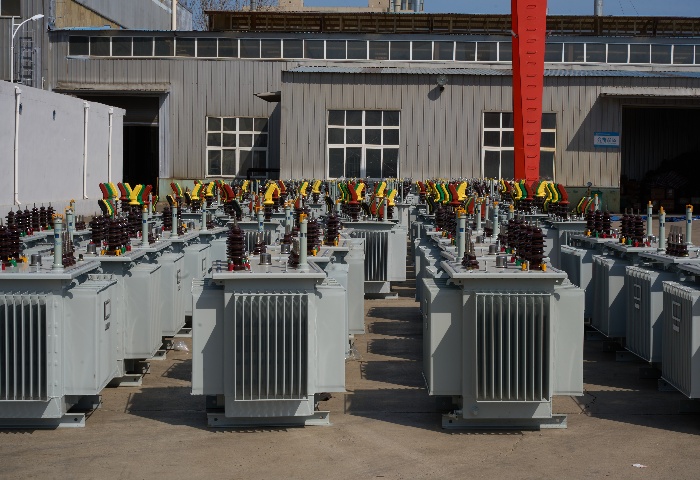
400kVA Oil Immersed Transformer
The 400kVA Oil Immersed Transformer produced by our company adopts a new insulation structure to improve the short-circuit resistance; the iron core is made of high-quality cold-rolled silicon steel sheet; the high-voltage winding is made of high-quality oxygen-free copper wire and adopts a multi-layer cylindrical structure; all fasteners are treated with special anti-loosening treatment. ONAN cooling, aluminum or copper windings, high-voltage 34.5kV / 24.94kV / 13.8kV / 12.47kV / 4.16kV (delta or wye), low-voltage 480Y/277V, 208Y/120V, 600Y/347V or custom, ±2×2.5% HV taps.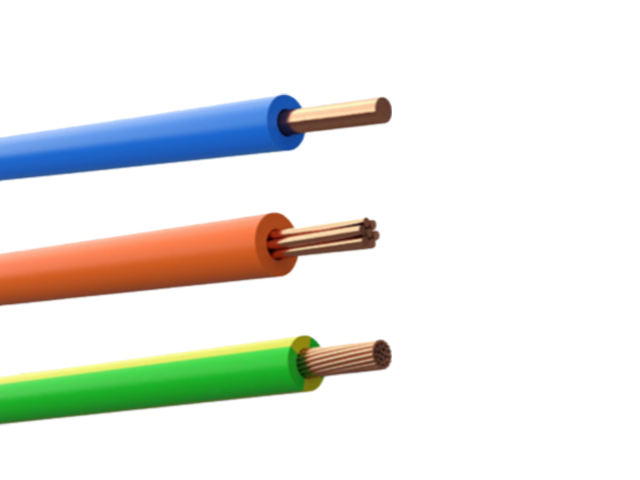
H07V-U H07V-R H07V-K
H07V-K cable is used for the internal wiring of electric motors and transformers as well as other electrical appliances and lighting applications. It can be used in and at electronic appliances for measuring, regulating and controlling. The cables are also ideal for laying in pipes, surface wiring and conduit installations. Specifications according to HD 516 apply for respective specific applications. H07V-U cable is intended for the installation to inside of apparatus as well as for the protective laying to the lightings, in dry rooms, in production facilities, switch and distributor boards, in tubes, under and surface mounting of plasters. H07V-R cable is preferably for installation indoors, in cable ducts, and in industrial plants or switching stations, under ground installation. It can be used in switchboards and distributor boards or where a thicker strand of multi-wire is required. Found in electronic and electrical equipment and switch gear cabinets designed for export to a European country and for MRO replacement of European-made equipment wire.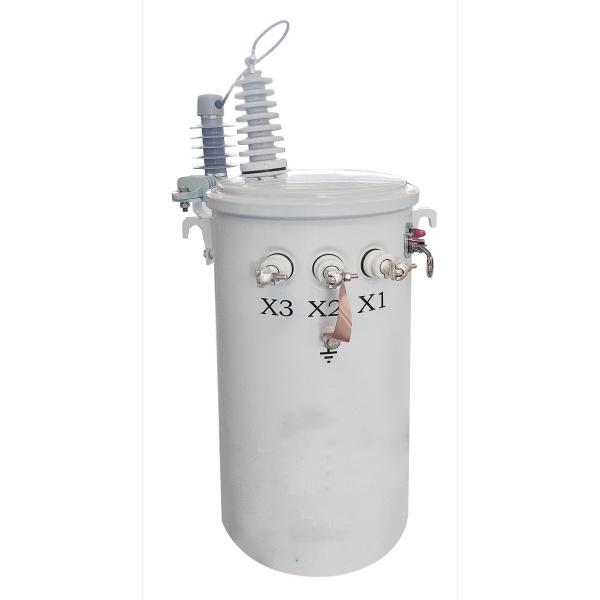
25kVA Completely self-protected(CSP) Single Phase Pole Mounted Transformer
The 25kVA Completely Self-Protected (CSP) Single Phase Pole Mounted Transformer is a compact, oil-immersed overhead distribution transformer with integrated self-protection for enhanced safety and reduced external equipment needs in residential, rural, small commercial, and light agricultural power supply. Compliant with ANSI C57.12.20, IEEE C57.12.00 / C57.12.90, DOE efficiency standards (meeting or exceeding DOE 2016 levels, aligned with 2029 amended requirements for reduced losses in single-phase units), and applicable CSA/IEC guidelines, this CSP unit delivers efficient step-down from medium-voltage primary lines to low-voltage secondary service, with built-in protection against overloads, faults, and surges, low no-load/load losses, and long service life in pole-mounted utility applications.
Three Phase Cast Resin Dry Type Transformer
The Three Phase Cast Resin Dry Type Transformer is a safe, high-efficiency indoor power transformer series designed for reliable medium-voltage to low-voltage step-down in commercial, institutional, industrial, data center, hospital, school, high-rise, and renewable energy applications. With advanced epoxy cast-resin encapsulation and full high-conductivity copper windings, it completely eliminates oil fire risks, environmental hazards, and routine maintenance while offering excellent dielectric strength, thermal performance, resistance to moisture/dust/chemicals, and very low noise levels — making it the ideal choice for fire-sensitive, noise-restricted, space-constrained, or high-reliability indoor installations. Fully compliant with IEC 60076-11, IEC 60076-1/2/3/5/20, EN 50588-1 (eco-design), IEEE C57.12.01, IEEE C57.12.91, UL 1561 (optional listing), and DOE 2016 efficiency standards.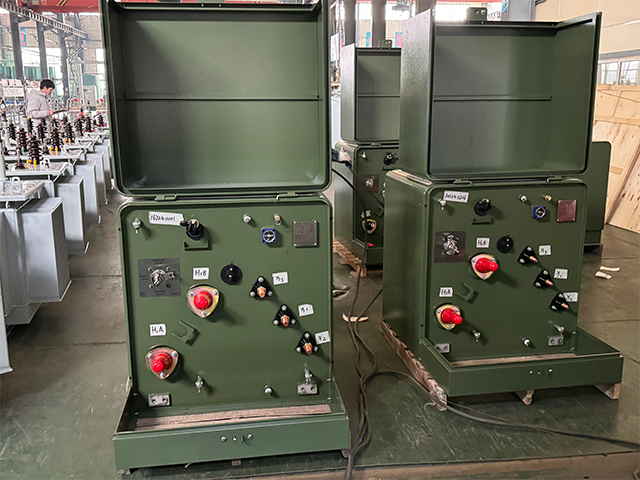
333kVA Single Phase Pad Mounted Transformer
The 333kVA Single Phase Pad Mounted Transformer is a high-performance electrical transformer designed for reliable power distribution in industrial and commercial applications. With a robust, weather-resistant enclosure, it is ideal for outdoor installations and offers efficient step-down voltage conversion. This transformer features a 333kVA capacity, providing reliable power to meet the demands of single-phase systems, and comes with customizable primary and secondary voltage configurations.
10kV Cast Resin Dry Type Transformer Copper Winding
The 10kV Cast Resin Dry Type Transformer Copper Winding, a high-reliability, oil-free power solution engineered for safe and efficient indoor medium-voltage distribution. This three-phase dry-type transformer features fully vacuum-cast epoxy resin encapsulation around high-purity copper windings, combined with premium low-loss grain-oriented silicon steel cores to deliver exceptional energy efficiency (typically 98%+), significantly reduced no-load and load losses, and outstanding partial discharge performance (<10pC). The cast resin design ensures superior moisture resistance, self-extinguishing fire safety (F1 class), robust short-circuit withstand, and maintenance-free operation. Natural air (AN) cooling with optional forced air (AF) upgrades supports high overload capacity while maintaining low acoustic emissions through advanced vibration isolation and optimized core/winding geometry. Compliant with IEC 60076-11 and equivalent standards, this transformer steps down 10kV primary (with ±2×2.5% or wider off-circuit taps) to 0.4kV secondary (Dyn11 vector group standard), making it the ideal choice for modern commercial, industrial, and utility indoor installations prioritizing safety, sustainability, and long-term performance.-AL-medium-voltage-power-cable-2.jpg)
RHZ1-2OL(S)-AL Medium Voltage Power Cable(8.7/15kV, 12/20kV, 18/30kV Specifications)
NPC Electric RHZ1-2OL(S)-AL Medium Voltage Power Cable (8.7/15kV, 12/20kV, 18/30kV) combines economy with special fire safety for demanding medium voltage networks. Built with aluminium conductors, thermosetting XLPE insulation, metallic screen, and specially formulated LSZH sheath with superior fire-retardant characteristics (S), it meets UNE 21123-4 and higher CPR classifications. The special LSZH sheath drastically reduces smoke and eliminates corrosive gases in fires. Lightweight aluminium minimizes costs and installation effort. Excellent partial discharge resistance, low tan delta, and thermal endurance ensure efficiency and longevity. Suitable for direct burial, ducts, or indoor use in high-risk areas, the RHZ1-2OL(S)-AL Medium Voltage Power Cable is favored for metro systems, data centers, public venues, and infrastructure demanding reliable medium voltage cabling with advanced fire protection, environmental compliance, and enhanced life-safety in populated or confined spaces.
75kVA Oil Immersed Transformer
75kVA oil-immersed transformer is an efficient and reliable power conversion device, which is widely used in power distribution systems in industrial, commercial, and construction sites. The transformer adopts oil-immersed cooling technology, has good heat dissipation performance, and can work continuously and stably under high load conditions. The 75kVA oil-immersed transformer also has complete protection functions, including overload protection, short-circuit protection, and temperature monitoring, to ensure the safety and stability of the equipment during operation.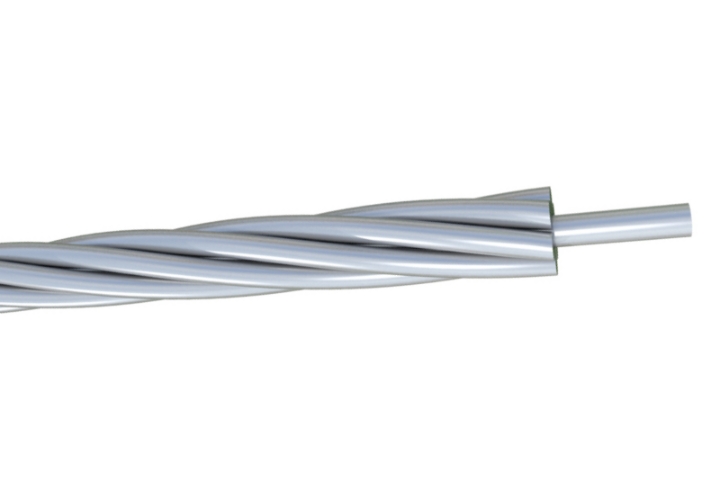
12 Gauge Galvanized Steel Conductor Wire
The 12 Gauge Galvanized Steel Conductor Wire is engineered for demanding utility applications, delivering reliable high-strength performance with outstanding corrosion resistance. Produced with heavy hot-dip galvanizing, this 12 AWG wire features a uniform zinc coating that effectively protects against rust in challenging environments. It performs exceptionally well as overhead ground wire, static wire, or guy wire for pole guying in power transmission and distribution systems. Meeting ASTM A475 requirements, the 12 Gauge Galvanized Steel Conductor Wire provides excellent tensile strength and long service life with minimal maintenance. Rigorous quality testing throughout production ensures consistent mechanical properties and coating integrity, making it a cost-effective and dependable solution for shielding and structural support in overhead lines.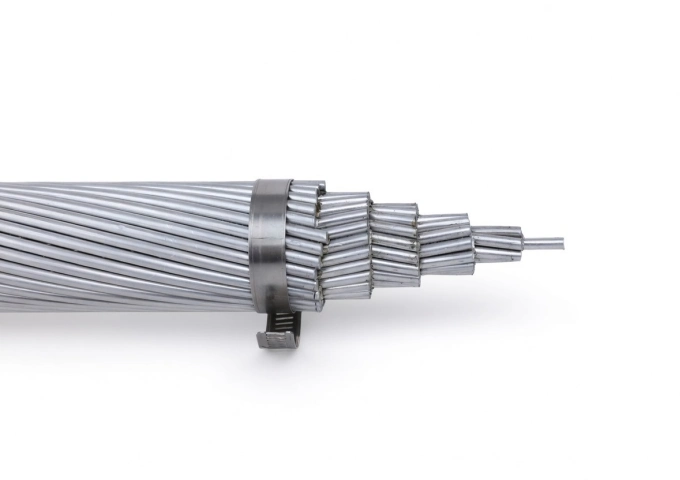
795 MCM Arbutus AAC Cable
The 795 MCM Arbutus AAC Cable represents premium All Aluminum Conductor technology for overhead power applications. Built with 37 strands of high-conductivity 1350-H19 aluminum, this bare conductor delivers an optimal balance of electrical efficiency and mechanical robustness. With a 1.026-inch diameter, 14,200 lbs breaking strength, and 880 amps ampacity, the Arbutus AAC offers low DC resistance of 0.0217 ohms per 1000 ft at 20°C and a weight of 746.7 lbs per 1000 ft. This design minimizes sag while providing excellent corrosion resistance for extended outdoor service. Manufactured to meet ASTM B-230 and B-231 standards, the 795 MCM Arbutus AAC Cable undergoes extensive quality testing from raw materials through finished product. It is the ideal solution for new installations and upgrades in transmission and distribution systems that demand lightweight, high-conductivity bare aluminum conductors.
1600kVA Oil Immersed Transformer
The 1600kVA Oil Immersed Transformer is a high-capacity, three-phase, liquid-filled distribution transformer engineered for reliable outdoor pad-mounted or substation installations in utility networks, large commercial/industrial complexes, data centers, manufacturing plants, and high-demand power distribution systems. Primary voltages range from 2.4kV to 34.5kV (common: 34.5kV, 24.94kV, 13.8kV, 13.2kV, 12.47kV, 4.16kV) in delta or grounded wye configurations with BIL up to 200kV. Secondary voltages include 600Y/347V, 480Y/277V, 208Y/120V, 240/120V, or custom outputs with vector groups Dyn11, Dyn1, Yyn0, etc.Welcome your inquiry
Honesty, Integrity, Frugality, Activeness and Passion