
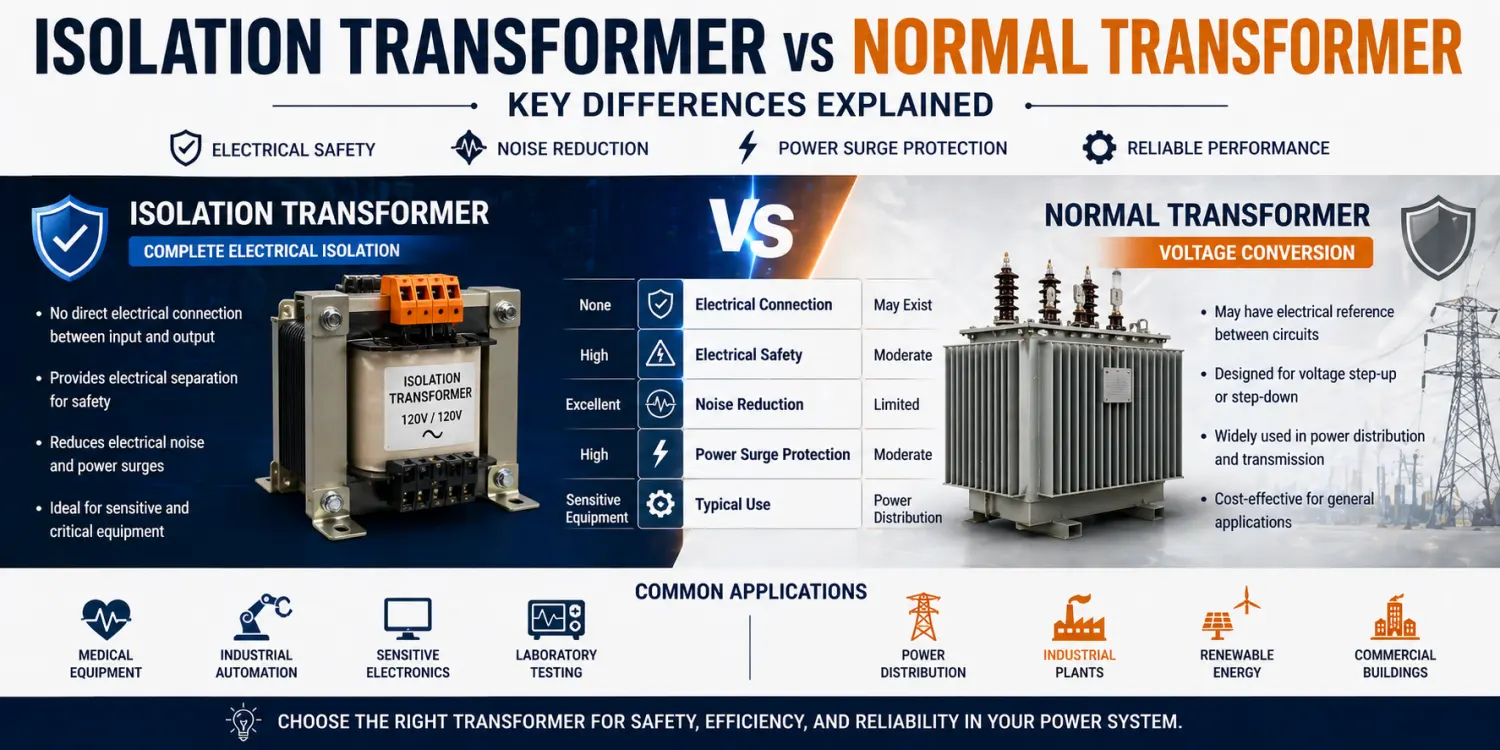
Isolation Transformer vs Normal Transformer: Key Differences Explained
2026-06-26
Introduction to Transformers in Modern Power Systems
Transformers are fundamental components in electrical engineering, relying on the principle of electromagnetic induction to transfer energy between circuits. A standard electrical transformer, often called a power transformer, steps voltage up or down to match system requirements while maintaining efficient power delivery. In contrast, an isolation transformer emphasizes complete electrical separation between its primary and secondary windings.
From a practical working perspective, engineers select transformers based on application demands such as voltage conversion, safety compliance, noise immunity, and fault tolerance. In today's interconnected power systems—ranging from industrial automation to healthcare facilities—understanding these distinctions ensures reliable operation, regulatory adherence (like IEC and UL standards for medical devices), and minimized downtime. Isolation transformers, particularly isolation transformer 120v models common in North American setups, play a vital role where human safety or equipment protection is paramount.
Fundamental Working Principle – Electromagnetic Induction in Both Types
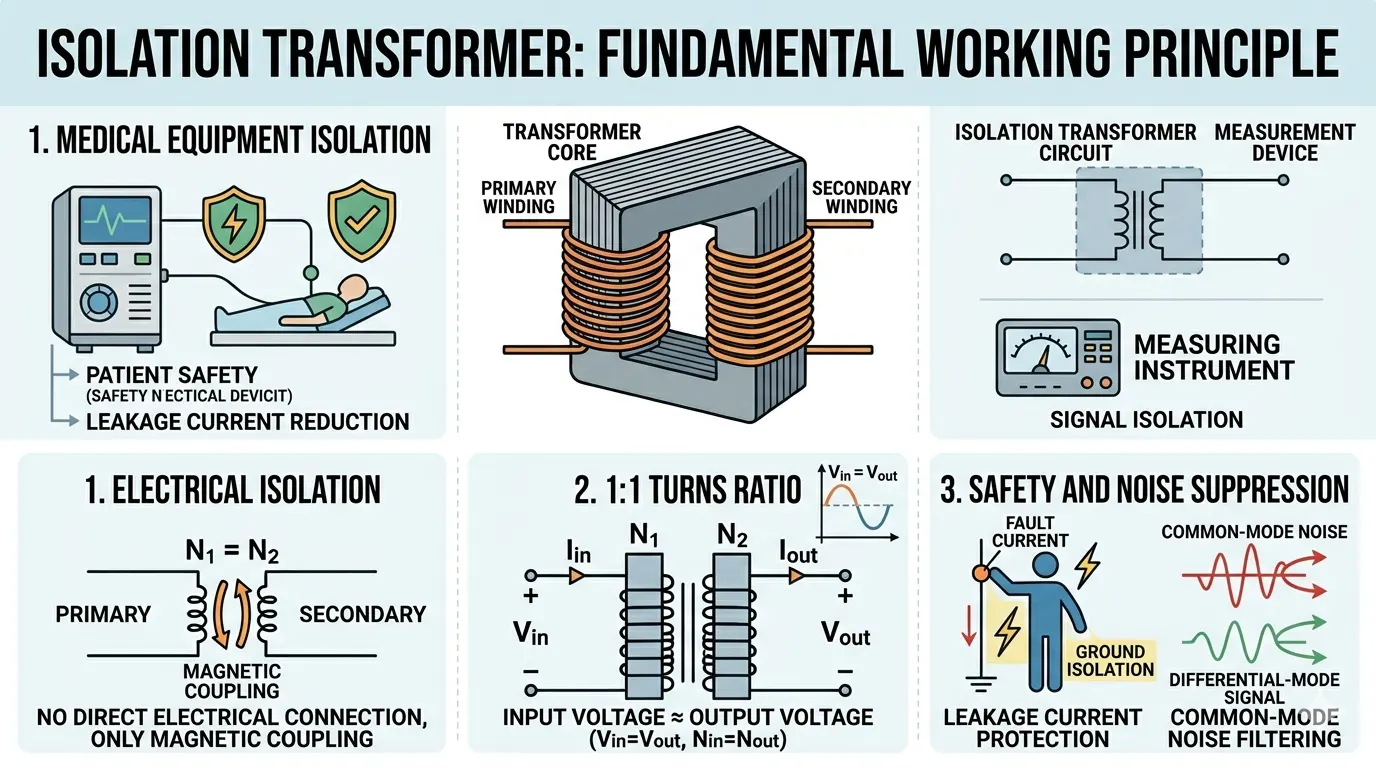
Both isolation transformers and regular transformers operate on Faraday's law of electromagnetic induction. Alternating current in the primary winding generates a varying magnetic flux in the shared core, typically constructed from laminated silicon steel to reduce eddy current and hysteresis losses. This flux induces a voltage in the secondary winding proportional to the turns ratio (N_secondary / N_primary).
In a normal power transformer, the primary and secondary windings share a common magnetic path, and while there is no direct conductive link in double-wound designs, the focus remains on efficient voltage transformation with minimal losses. Engineers calculate core saturation (B_max), winding resistance, and leakage inductance to optimize efficiency, often exceeding 95-98% in large units.
For isolation transformers, the same induction principle applies, but design prioritizes maximizing physical and dielectric separation. Windings are often placed in separate compartments or with enhanced insulation barriers, including a Faraday shield (electrostatic screen) grounded to divert capacitive coupling currents. This reduces common-mode noise transfer. In real-world testing, engineers measure inter-winding capacitance, which is significantly lower in isolation designs (pF range) compared to standard transformers. The result is true galvanic isolation—no DC path exists between input and output circuits.
From an operational viewpoint, this shared principle means both types handle AC power at line frequencies (50/60 Hz), but isolation transformers maintain waveform integrity better under noisy conditions.
Structural Design Differences – Primary and Secondary Windings Configuration
The physical construction reveals the most significant divergence. In a regular transformer, primary and secondary windings may be layered concentrically on the same bobbin for compactness and better magnetic coupling, reducing leakage flux. This design favors cost and size efficiency in power distribution applications where voltage step-up or step-down is the goal.
Isolation transformers, however, employ separated winding techniques—often side-by-side or with substantial physical barriers—to achieve high dielectric strength (thousands of volts isolation rating). A key feature is the optional electrostatic shield between windings, which intercepts capacitive currents and routes them to ground, preventing noise propagation. Modern designs incorporate advanced insulation materials like Nomex or epoxy impregnation to withstand higher hipot test voltages.
In practice, engineers specify isolation transformers with a 1:1 turns ratio for applications needing no voltage change, such as isolation transformer 120V units that deliver 120V output from 120V input while breaking ground loops. Regular transformers rarely prioritize this; their ratios are tailored for conversion (e.g., 480V to 208V). Field data shows isolation designs are bulkier and heavier due to extra insulation and core material, but offer superior transient withstand capability.
This structural rigor directly impacts thermal management: isolation units often run cooler under no-load due to reduced parasitic currents.
The structural distinctions become evident when examining the following comparison:
Table 1:Design and Construction Comparison
|
Parameter |
Normal / Power Transformer |
Isolation Transformer |
|
Primary-Secondary Connection |
Magnetic coupling only (no direct electrical in double-wound) |
Full galvanic isolation with enhanced dielectric barriers |
|
Turns Ratio |
Variable (step-up or step-down, e.g., 2:1, 1:2) |
Typically 1:1 (isolation transformer 120v models maintain equal voltage) |
|
Winding Configuration |
Often concentric layers for tight coupling |
Side-by-side or compartmentalized with physical separation |
|
Electrostatic Shield (Faraday Shield) |
Rarely present |
Commonly included and grounded to reduce capacitive coupling |
|
Inter-winding Capacitance |
Higher (typically 100–500 pF) |
Significantly lower (typically <50 pF) |
|
Typical Core Type |
Laminated silicon steel |
Laminated or toroidal with advanced insulation |
|
Dielectric Strength (Hipot Test) |
Standard (1–2 kV) |
High (4 kV or higher for reinforced insulation) |
Electrical Isolation and Safety – Breaking Conductive Paths
Electrical isolation defines the isolation transformer. There is no electrical connection between input and output circuits; energy transfers solely via magnetic fields. This galvanic isolation protects against ground faults, where a fault on the secondary side does not energize the primary ground, reducing shock hazards.
In contrast, a normal transformer, even double-wound, may allow indirect coupling through shared grounds or higher capacitive leakage, potentially propagating faults. From a working angle, electricians and maintenance teams value isolation transformers in scenarios involving patient contact or sensitive electronics. Leakage current is minimized to microamp levels, complying with medical standards like IEC 60601.
Practical testing involves applying high voltage between windings and measuring leakage. Isolation transformers routinely pass 4kV or higher tests. In power surges, the isolation prevents surge energy from jumping circuits directly, though suppression devices are still recommended. Regular transformers offer basic transformation but lack this robust barrier, making them less suitable for high-risk environments.
Engineers note that while both provide some separation, only designed isolation transformers guarantee "electrical separation transformer" performance under fault conditions.
Performance in Power Surges and Noise Suppression
Power surges and electromagnetic interference (EMI/RFI) challenge modern systems. A regular power transformer passes differential-mode noise relatively easily due to tighter coupling. Isolation transformers excel here because of the Faraday shield and physical separation, attenuating common-mode noise by 60-100 dB depending on frequency.
In real installations, such as data centers or laboratories, engineers observe reduced equipment malfunctions when deploying power isolation transformers. Surges induced on the primary are not conductively transferred; the magnetic core saturates or dissipates energy differently. For isolation transformer 120v models, this protection is critical in residential or light commercial setups with variable loads.
Quantitative analysis in design labs uses oscilloscopes to compare before/after waveforms. Isolation units demonstrate cleaner output sine waves under distorted input conditions. Regular transformers, optimized for efficiency, may introduce more harmonics or allow ground loops that amplify noise in audio, medical imaging, or control systems.
This makes isolation transformers preferable in environments with frequent switching loads or nearby lightning-prone areas.
From a practical engineering and safety compliance perspective, the performance differences are quantified in the table below:
Table 2:Electrical Performance and Safety Parameters
|
Parameter |
Normal / Power Transformer |
Isolation Transformer (incl. Medical Grade) |
|
Galvanic Isolation |
Limited (possible indirect coupling via ground) |
Complete (no DC conductive path between input and output circuits) |
|
Leakage Current (Primary to Secondary) |
Typically 0.5–5 mA |
Very low (<100 µA normal, <50 µA for medical models) |
|
Common-Mode Noise Rejection |
Moderate (20–40 dB) |
Excellent (60–100 dB with Faraday shield) |
|
Surge Protection Capability |
Basic voltage transformation only |
Superior transient isolation and suppression support |
|
Patient/Operator Safety (Medical) |
Not certified for direct patient contact |
Compliant with IEC 60601 / UL 60601 (patient leakage ≤100 µA) |
|
Isolation Voltage Rating |
1–2.5 kV typical |
4 kV+ (reinforced/double insulation) |
Applications in Medical Equipment and Sensitive Systems
Medical equipment demands the highest safety margins. Medical isolation transformers provide electrical separation to limit patient leakage current, even if internal faults occur. Devices like ECG monitors, anesthesia machines, and imaging systems use these to float the secondary circuit, ensuring no path for fault current through the patient.
From a design engineer's perspective, compliance testing includes creepage and clearance distances per safety standards. Isolation transformers here often feature low-leakage designs and toroidal cores for reduced stray fields. Regular transformers lack the certified isolation levels needed, risking non-compliance or equipment damage during power events.
Beyond medicine, marine, industrial control, and telecommunications applications leverage isolation for similar reasons—preventing corrosion from stray currents or protecting PLCs from ground potential differences. In contrast, standard power transformers dominate utility-scale voltage conversion where safety isolation is secondary to efficiency and cost.
Real-world case studies show fewer downtime incidents in hospitals using dedicated power isolation transformer setups.
Efficiency, Cost, and Operational Trade-offs
Efficiency comparisons require nuance. Regular transformers achieve higher peak efficiencies in voltage-conversion roles due to optimized coupling and lower material use. Isolation transformers may exhibit slightly lower efficiency (1-3% difference) because of added insulation and shielding, which increase resistance or core losses marginally. However, in no-load or light-load scenarios common in standby medical systems, isolation designs can prove more energy-efficient by eliminating ground loop currents.
Cost-wise, isolation transformers are more expensive due to specialized construction, higher-grade materials, and rigorous testing. From procurement and installation viewpoints, engineers weigh total ownership cost: isolation units reduce maintenance from surge-related failures and extend equipment life.
In field operations, size and weight matter—toroidal isolation transformers offer compact, low-noise alternatives to traditional laminated cores. Selection involves load calculations, inrush current handling, and environmental factors like temperature rise (typically Class B or F insulation).
To support real-world selection and operational decision-making, consider the following operational comparison:
Table 3:Application and Operational Characteristics
|
Parameter |
Normal / Power Transformer |
Isolation Transformer |
|
Primary Purpose |
Voltage step-up/step-down in power distribution |
Electrical separation, noise reduction, and safety |
|
Typical Efficiency (Full Load) |
95–98% |
92–96% (slightly lower due to extra insulation) |
|
Relative Cost |
Lower (optimized for material efficiency) |
1.5–3× higher (due to shielding and testing) |
|
Size & Weight (for same kVA) |
More compact |
Larger and heavier (extra barriers and core material) |
|
Key Applications |
Utility grid, industrial power conversion |
Medical equipment, sensitive electronics, labs, and marine systems |
|
Noise & EMI Performance |
Standard |
Superior (reduces the impact of ground loops and power surges) |
|
Maintenance Focus |
Voltage regulation and thermal management |
Insulation resistance, leakage current testing |
Selection Criteria from a Practical Engineering Perspective
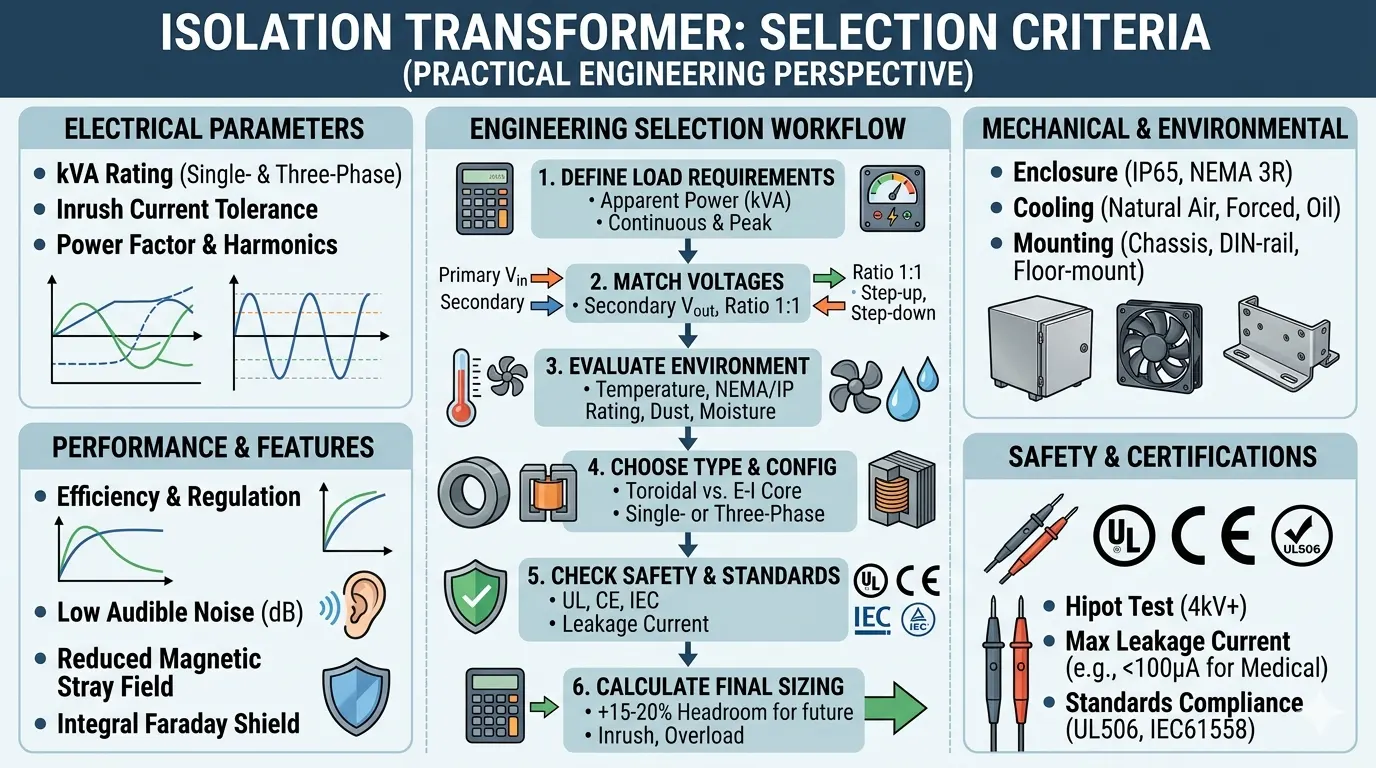
Choosing between types starts with defining requirements: Is voltage transformation primary, or is safety isolation essential? For pure power delivery, select a standard electrical transformer sized for KVA rating with appropriate regulation. For sensitive loads, specify an isolation transformer with documented isolation voltage, shielding, and agency approvals.
Engineers perform site surveys for noise levels, ground integrity, and surge exposure. Modern design software simulates magnetic fields and thermal profiles. Installation best practices include proper grounding of the shield (if present) and avoiding secondary grounding in certain floating configurations. Maintenance involves insulation resistance testing (megger) and thermal imaging to detect hot spots early.
In international exports, compliance with regional standards (UL, CE, CSA) differentiates products. Isolation transformer 120V variants are popular for the US/Canada markets, while 230V equivalents serve Europe.
Conclusion – Choosing the Right Transformer for Safety and Reliability
The key differences between isolation transformers and normal (regular) transformers stem from purpose: voltage transformation versus electrical isolation. While both rely on electromagnetic induction and feature primary and secondary windings, isolation designs deliver galvanic separation, superior noise rejection, and enhanced protection against power surges—critical for medical equipment electrical separation and other high-stakes applications.
In practical engineering workflows, prioritizing isolation transformers where human safety or signal integrity matters yields long-term benefits despite higher upfront costs. As power systems evolve with renewables and sensitive electronics, understanding these distinctions empowers better system design and operational resilience.

Related Articles


Related Products
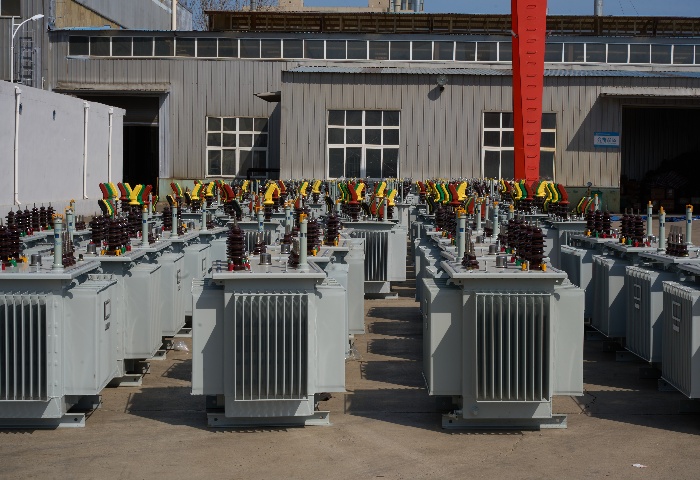
3150kVA Oil Immersed Transformer
3150kVA Oil Immersed Transformer is a high-capacity three-phase power transformer optimized for efficient voltage transformation in 50/60Hz AC medium-voltage networks, with primary ratings commonly at 11kV, 22kV, 33kV, or 35kV (adaptable to 10–38.5kV) and secondary at 0.4kV, 0.69kV, 6.3kV, 10kV, or 11kV. Employing advanced high-permeability grain-oriented silicon steel core (S13/S20 series compliant) for dramatically reduced no-load losses (typically 3200–5400W), high-purity copper windings, and premium insulating oil (IEC 60296 compliant, dielectric >60kV/2.5mm), it achieves low load losses (around 18–22kW at 75°C), strong overload capability (up to 150–180% short-duration), noise below 65dB, and efficiency exceeding 99%.This transformer minimizes operational expenses, transmission losses, and environmental impact in large-scale industrial, utility, and renewable setups.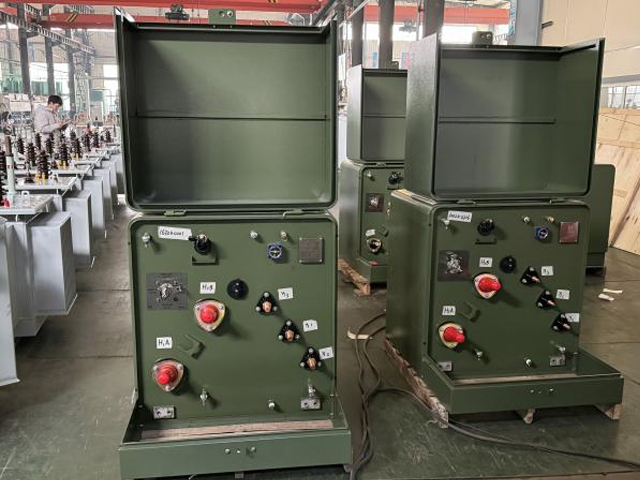
15kVA Conventional Type Single Phase Pole Mounted Transformer
NPC ELECTRIC has been focusing on the production of 15kVA Conventional Type Single Phase pole Mounted transformer for more than 20 years, which complies with IEC 60076, ANSI C57.12.20, EN 50464-1, ISO 9001 standards. NPC ELECTRIC'S transformer adopts oil-immersed self-cooling design, which can efficiently and stably convert high-voltage electricity into low-voltage electricity suitable for users. It is mainly used for power supply needs of rural areas, end of the power grid and small industrial users. Typical features include mineral oil insulation (ONAN cooling), aluminum or copper windings, primary voltages from 2.4kV to 34.5kV (e.g., 7200/12470GrdY, 7620/13200GrdY, 12470GrdY/7200, 24900GrdY/14400), secondary voltages 120/240V or 240/120V split-phase, BIL ratings 60-150kV on HV and 30kV on LV, impedance around 2-3.5%, ±2×2.5% taps, conventional or CSP (completely self-protected) configurations with internal fuses, arresters, and weak-link protection, pressure relief valve, oil sight gauge, and ANSI 70 gray tank finish.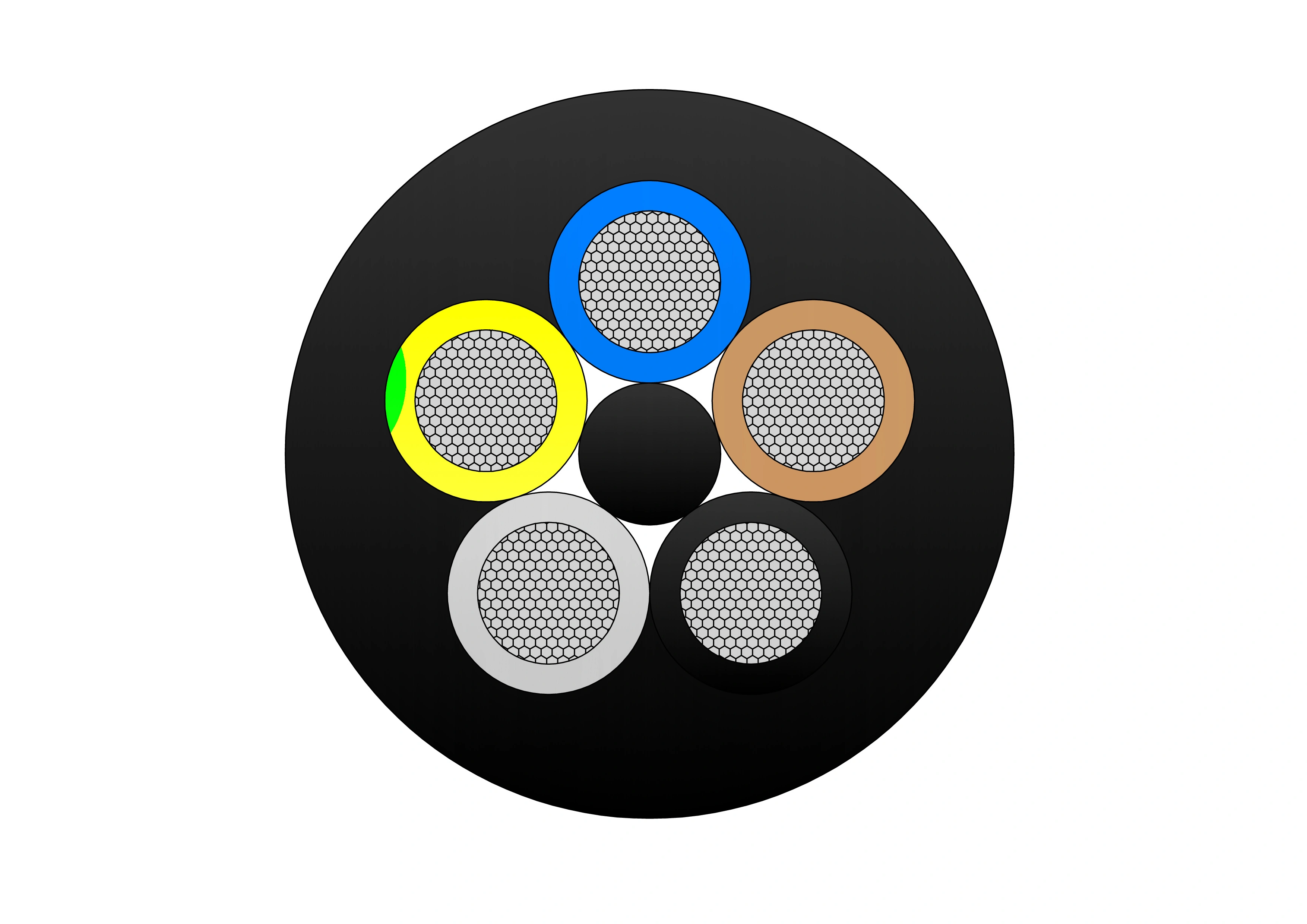
Type 440 Flexible Copper Screened Mining Cable With Three Pilot Core Interstitial
The Type 440 Flexible Copper Screened Mining Cable is a medium-voltage mining cable designed for heavy-duty applications in draglines, shovels, and large drills.It features tinned annealed copper conductors, EPR insulation, and a flexible copper wire screen for superior electrical shielding. Its three pilot cores allow for enhanced monitoring and control in mining operations. The extra heavy-duty PCP sheath provides oil resistance, abrasion protection, and flame retardancy, making it suitable for harsh mining environments. Compliant with AS/NZS 2802 and related standards, this cable ensures long service life and high mechanical performance in demanding conditions. Its flexible construction allows for repeated bending and movement under harsh operating conditions. The outer sheath provides excellent resistance to abrasion, oil, moisture, impact, and environmental aging. Manufactured under strict quality control procedures, the Type 440 mining cable undergoes comprehensive raw material testing, process inspection, and finished product testing to ensure compliance with mining regulations and long-term performance.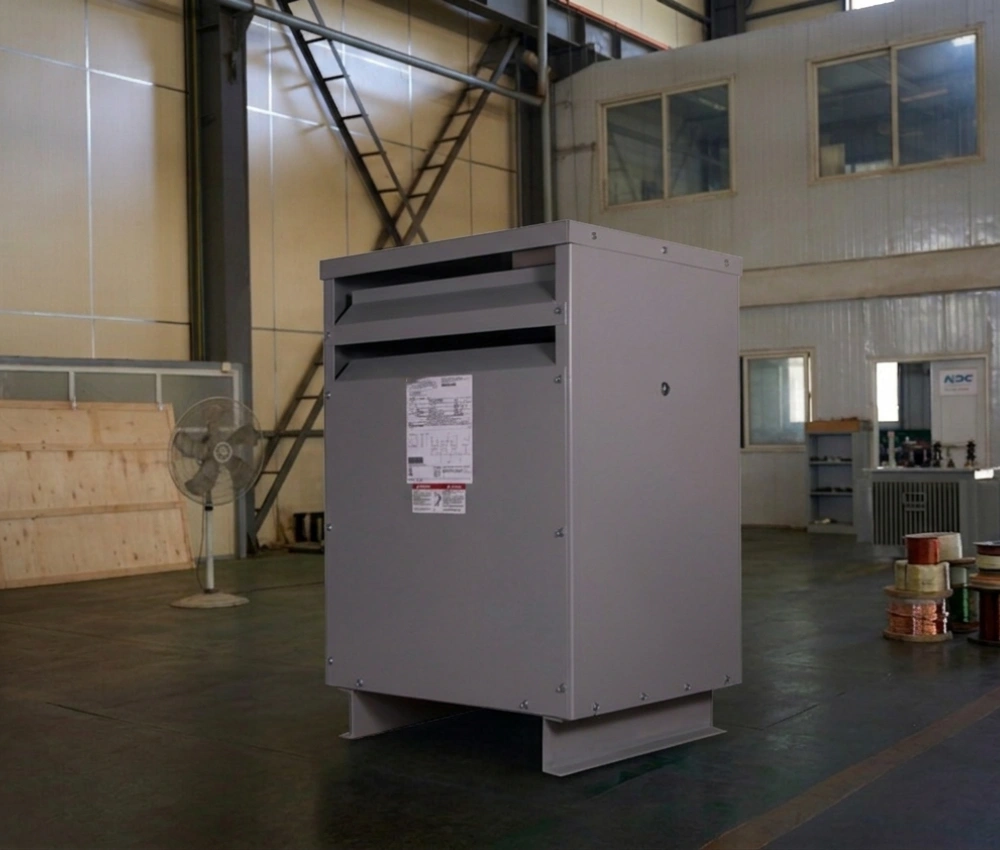
Dry Type Isolation Transformer
The Dry Type Isolation Transformer is a highly reliable power conditioning and electrical isolation solution designed to provide complete galvanic separation between input and output circuits. By eliminating direct electrical connections between the primary and secondary windings, the transformer effectively reduces electrical noise, suppresses transient disturbances, minimizes ground loop currents, and enhances system safety. Its oil-free design makes it particularly suitable for indoor installations where environmental protection, fire safety, and operational reliability are critical requirements. Manufactured using high-grade silicon steel cores, advanced vacuum pressure impregnated (VPI) insulation technology, and precision-wound copper or aluminum conductors, the Dry Type Isolation Transformer delivers superior voltage regulation, thermal stability, and dielectric performance. The transformer is widely utilized in industrial automation systems, medical facilities, commercial buildings, telecommunications infrastructure, data centers, renewable energy installations, and sensitive electronic equipment applications. Its maintenance-friendly design and robust construction ensure long service life and dependable performance under demanding operating conditions.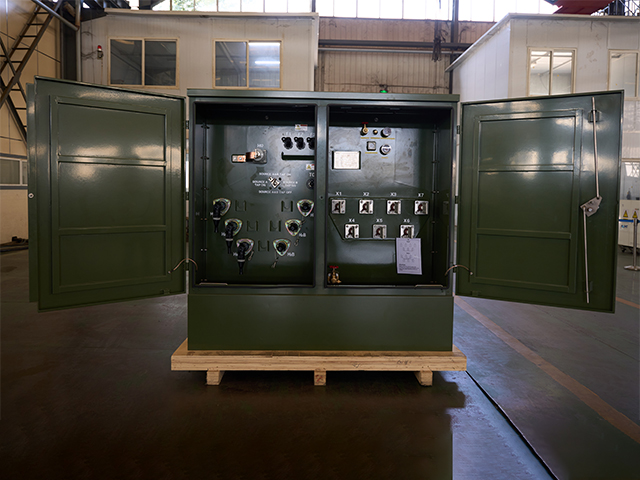
2000kVA Three Phase Pad Mounted Transformer
2000kVA Three Phase Pad Mounted transformer adopts a fully sealed oil-immersed design, which complies with international standards such as IEC, ANSI and GB. It has the characteristics of high efficiency, low loss and strong weather resistance. It is widely used in industrial parks, commercial complexes, power companies and new energy projects, and is particularly suitable for medium and large load environments that require both stable power supply and energy saving.
(N)TSCGEWOU 3.6/6kV, 6/10kV, 8.7/15kV and 12/20kV FO Cable
The (N)TSCGEWOU 3.6/6kV, 6/10kV, 8.7/15kV and 12/20kV FO Cable is a flexible, heavy-duty medium-voltage trailing/reeling cable with integrated fiber optic (FO) elements for combined power and high-speed data transmission in mining and tunneling. It features class 5 finely stranded tinned copper phase conductors for flexibility and corrosion resistance, semi-conductive screens, EPR insulation for superior dielectric strength and 90°C rating, copper braid screen for EMI protection and grounding, control conductors, monitoring conductor (ÜL), central or distributed multimode/single-mode fiber optic cores (protected in gel-filled tubes for water resistance and mechanical protection), and a tough rubber outer sheath resistant to oil, flame, abrasion, and mechanical stress. Compliant with DIN VDE 0250 and relevant IEC standards, it supports high tensile loads, fast reeling speeds, and tight bending radii while enabling real-time monitoring and communication. The (N)TSCGEWOU FO ensures safe, reliable MV power and data delivery to mobile equipment like shearers, tunnel boring machines, and smart conveyors in harsh underground environments.
75kVA Conventional Type Single Phase Pole Mounted Transformer
NPC ELECTRIC has been specialized in manufacturing 75kVA Conventional Type Single Phase pole Mounted transformer for more than 20 years, which complies with international standards such as ANSI/IEEE C57, IEC60076 and other standards. Its main function is to convert high voltage electricity (such as 11kV, 13.8kV, etc.) into low voltage electricity (such as 120V/240V), providing stable and reliable power supply to end users. It is suitable for residential, commercial, agricultural and small industrial loads. Typical specifications include mineral oil insulation (ONAN cooling), aluminum or copper windings, primary voltages 2.4kV–34.5kV grounded wye or delta (common: 7200/12470GrdY, 7620/13200GrdY, 12470GrdY/7200, 24940GrdY/14400, 34500GrdY/19920), secondary 120/240V or 240/120V split-phase, BIL ratings 95–150kV HV / 30kV LV, impedance typically 2.0–4.0%, ±2×2.5% or 5-position tap changer, conventional or CSP (completely self-protected) configurations with internal fuses, lightning arresters, weak-link protection, pressure relief valve, oil sight gauge, and ANSI 70 gray tank finish. Efficiency typically reaches 99.17–99.19% at 50% load per DOE levels, with low sound levels and corrosion-resistant hardware for extended outdoor service.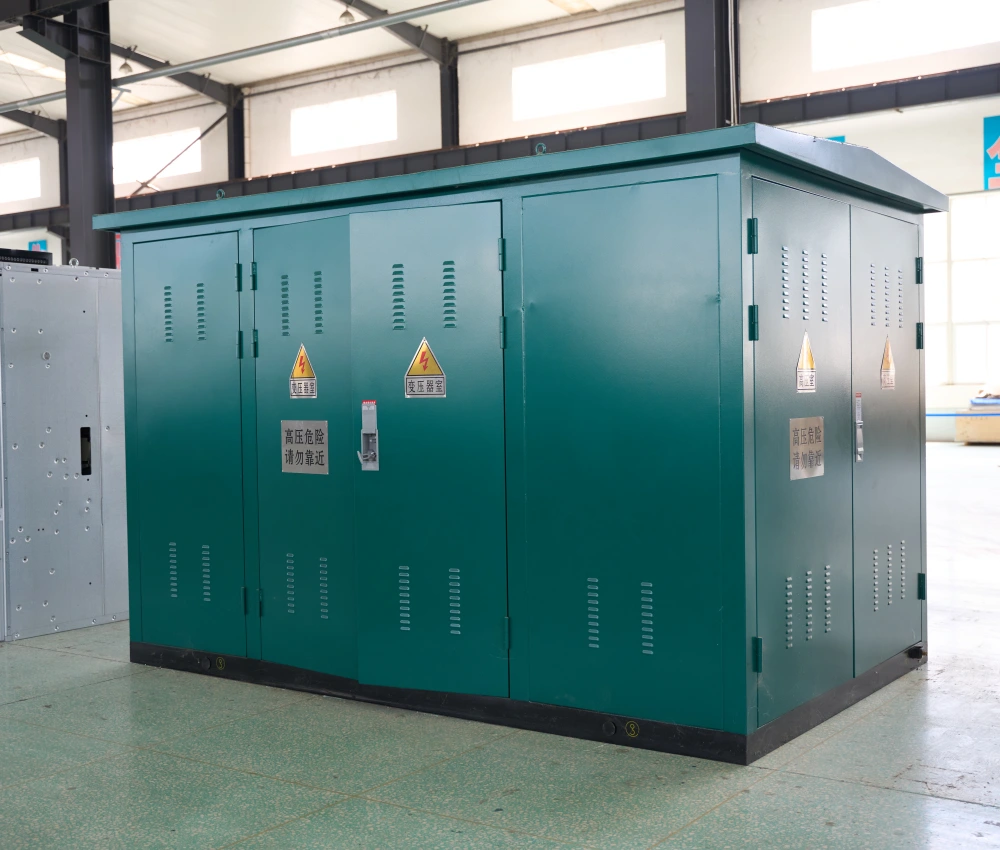
11kV 800kVA Prefabricated Compact Substation
The 11kV 800kVA Prefabricated Compact Substation is an advanced integrated power distribution system designed to provide safe, efficient, and reliable medium-voltage to low-voltage energy transformation for industrial, commercial, and infrastructure applications. The substation integrates 11kV medium-voltage switchgear, an 800kVA distribution transformer, low-voltage distribution equipment, and intelligent protection systems into a compact outdoor enclosure, significantly reducing installation space and on-site construction requirements. Built for continuous operation in demanding environments, the compact substation features a durable weather-resistant enclosure, optimized thermal ventilation structure, high-performance insulation system, and reinforced electrical safety protection. Its modular architecture simplifies transportation, accelerates installation, and minimizes maintenance complexity while ensuring stable long-term operational performance. The 11kV 800kVA compact transformer substation is suitable for utility distribution systems, renewable energy integration, manufacturing facilities, commercial complexes, and urban electrical infrastructure projects. With optional intelligent monitoring and remote communication functions, the substation supports modern smart-grid applications and improves operational efficiency across distributed power networks.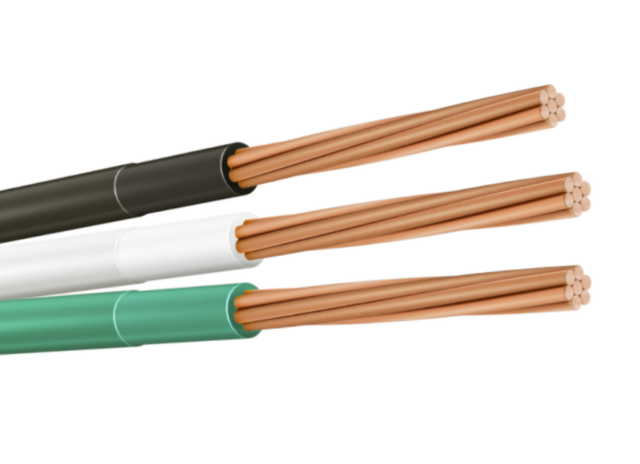
THHN AND THWN
Electrical wire THHN THWN is used in new construction projects or rewiring tasks in 600-volt systems. Versatile and usable in both wet and dry locations, THHN/THWN-2 is an excellent choice for a wide range of electrical installations. THHN/THWN-2 conductors can withstand temperatures up to 90°C in dry environments and up to 75°C in the presence of oil or coolant. Its outer nylon jacket is smooth and fine, ensuring easy installation by reducing friction during pulling. This feature is especially useful for long or challenging runs.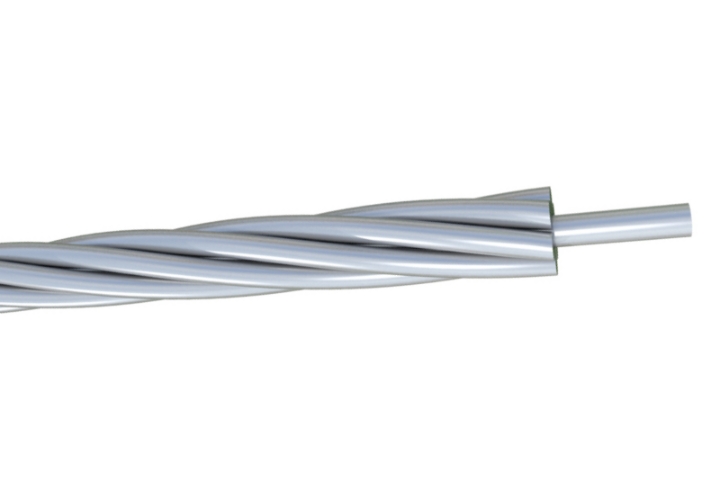
10 Gauge Galvanized Steel Conductor Wire
The 10 Gauge Galvanized Steel Conductor Wire is a premium high-strength bare steel wire designed for reliable overhead power line applications. Manufactured with heavy hot-dip zinc coating, this 10 AWG galvanized conductor delivers superior corrosion resistance and long service life in harsh outdoor environments. It offers excellent tensile strength and mechanical performance, making it ideal for use as overhead ground wire (static wire), guy wire, or messenger wire. Fully compliant with ASTM A475 and related utility standards, the 10 Gauge Galvanized Steel Conductor Wire undergoes rigorous testing from raw materials to finished product to ensure uniform zinc adhesion, consistent diameter, and high breaking strength. Its durable construction minimizes maintenance while providing dependable shielding and structural support for transmission and distribution systems.
10kV Cast Resin Dry Type Transformer Copper Winding
The 10kV Cast Resin Dry Type Transformer Copper Winding, a high-reliability, oil-free power solution engineered for safe and efficient indoor medium-voltage distribution. This three-phase dry-type transformer features fully vacuum-cast epoxy resin encapsulation around high-purity copper windings, combined with premium low-loss grain-oriented silicon steel cores to deliver exceptional energy efficiency (typically 98%+), significantly reduced no-load and load losses, and outstanding partial discharge performance (<10pC). The cast resin design ensures superior moisture resistance, self-extinguishing fire safety (F1 class), robust short-circuit withstand, and maintenance-free operation. Natural air (AN) cooling with optional forced air (AF) upgrades supports high overload capacity while maintaining low acoustic emissions through advanced vibration isolation and optimized core/winding geometry. Compliant with IEC 60076-11 and equivalent standards, this transformer steps down 10kV primary (with ±2×2.5% or wider off-circuit taps) to 0.4kV secondary (Dyn11 vector group standard), making it the ideal choice for modern commercial, industrial, and utility indoor installations prioritizing safety, sustainability, and long-term performance.
(N)TSCGEWOU 3.6/6kV, 6/10kV, 8.7/15kV and 12/20kV ATB Cable
The (N)TSCGEWOU 3.6/6kV, 6/10kV, 8.7/15kV, and 12/20kV ATB Cable is a medium voltage flexible power cable designed in compliance with VDE 0250 standards. It features Class 5 tinned copper conductors, EPR rubber insulation, semi-conductive layers, halogen-free flame-retardant rubber sheath, and an earth detection conductor. The ATB construction ensures superior mechanical strength, oil resistance, abrasion resistance, and flame retardancy, making it ideal for open-pit mining, tunneling, and other heavy-duty mobile equipment applications under extreme mechanical stress. It includes tinned class 5 copper phase conductors, semi-conductive screens, EPR insulation for reliable dielectric and thermal performance (90°C rating), copper braid screen, control conductors, monitoring conductor (ÜL), anti-torsion braid to reduce twisting under load, and a robust rubber sheath resistant to oils, flames, abrasion, and mechanical damage.
397.5 MCM CHICKADEE ACSR Conductor Cable
The ACSR Chickadee is a compact yet high-performance aluminium conductor steel reinforced cable, engineered for efficient energy transmission in overhead power systems. Constructed with hard-drawn 1350-H19 aluminium wires helically stranded around a galvanized steel core, this conductor is optimized to provide excellent electrical conductivity along with the mechanical strength needed for long-span and high-load applications. Compliant with ASTM B232 standards, the Chickadee conductor is suitable for primary and secondary bare cable use in transmission and distribution networks. The galvanized steel core, treated with Class A or B coating, ensures long-term corrosion resistance, even in aggressive outdoor environments. Ideal for compact power line installations or regions with light-to-moderate mechanical stress, Chickadee offers a reliable and cost-effective solution without compromising performance or safety.
Three Phase Pole Mounted Transformer
The three phase pole mounted transformer delivers balanced, high-capacity power transformation for overhead distribution lines, stepping down medium voltages such as 11kV, 22kV, or 33kV to low voltages like 400V/415V or 480V in Y or Delta configurations. Engineered with a five-legged core/coil assembly and premium grain-oriented silicon steel, it reduces magnetic losses and harmonics while achieving high efficiency levels per DOE and IEC standards. The oil-immersed tank with ONAN cooling ensures effective heat dissipation and a 65°C rise rating for continuous operation under demanding loads. Robust features include porcelain HV bushings, polymer LV bushings, tin-plated terminals for copper/aluminum connections, pressure relief devices, and lightning arrester provisions, offering excellent weather resistance and protection in exposed installations. This design provides cleaner aesthetics, lower installation costs compared to single-phase banks, and reliable service for motor starts and variable loads, making it a top choice for utilities modernizing grids.
Steel Tape Armoured Cable Type
The Steel Tape Armoured Cable (STA Cable) is designed for reliable power transmission in environments requiring enhanced mechanical protection. Manufactured with high-quality copper or aluminum conductors, XLPE insulation, galvanized steel tape armour, and a durable PVC outer sheath, the cable provides exceptional durability and long-term operational reliability. The galvanized steel tape armour offers superior resistance against mechanical impact, compression, and external damage, making the cable suitable for underground installations and harsh industrial environments. The XLPE insulation ensures excellent electrical performance, low dielectric losses, and continuous operating temperatures up to 90°C. The PVC sheath protects the cable against moisture, chemicals, abrasion, and environmental exposure, extending service life and reducing maintenance requirements. Manufactured according to IEC 60502-1 and other international standards, the cable is widely used in power distribution networks, industrial facilities, infrastructure projects, renewable energy installations, and utility systems. The Steel Tape Armoured Cable combines electrical efficiency, mechanical strength, and installation flexibility, making it a dependable solution for demanding power distribution applications.Welcome your inquiry
Honesty, Integrity, Frugality, Activeness and Passion