
Best Ways to Reduce Transformer Hum: Vibration Isolation and Soundproofing Tips
2026-03-26
Transformer hum is one of the most persistent and annoying issues in electrical installations worldwide. The characteristic low-frequency buzzing sound, typically at 100 Hz or 120 Hz, not only disturbs occupants but can also indicate underlying mechanical stress that may affect long-term reliability. This comprehensive guide explores the best ways to reduce transformer hum using proven vibration isolation and soundproofing techniques that deliver measurable results for both dry type transformers and pad-mounted transformers.
Transformer noise primarily originates from magnetostriction in the silicon steel core, where alternating magnetic fields cause the core laminations to expand and contract rapidly. Additional contributions come from electromagnetic forces on windings, loose components, and structure-borne vibration transmission. Higher flux density, poor core clamping, and inadequate mounting further amplify noise levels, often pushing standard electric transformers beyond acceptable limits in commercial, industrial, and residential environments.
Fortunately, modern engineering offers effective solutions. By combining optimized design practices from leading transformer manufacturers with practical on-site measures such as high-performance vibration isolators, neoprene pads, spring mounts, acoustic enclosures, and strategic soundproofing, it is possible to achieve noise reductions of 8–15 dB(A) or more. These methods address both the source of the hum and its transmission paths while maintaining thermal performance and operational efficiency.
Whether you are specifying a new low-noise transformer or retrofitting an existing unit, this article provides science-based, field-proven strategies to significantly lower humming noise in transformers and create quieter, more comfortable working environments.
1. Mechanisms Behind Transformer Hum
Transformer hum is primarily caused by magnetostriction — the slight expansion and contraction of the silicon steel core laminations under an alternating magnetic field. When AC voltage is applied, the magnetic flux density changes direction twice per cycle, causing the core to vibrate at twice the supply frequency: 100 Hz in 50 Hz systems and 120 Hz in 60 Hz systems. This microscopic dimensional change (typically a few micrometers per meter) generates mechanical vibrations that produce the characteristic low-frequency humming noise.
Additional contributing factors include electromagnetic forces on windings, loose laminations, core clamping pressure, and resonance in the transformer structure or mounting. Higher flux density significantly increases magnetostriction amplitude, resulting in louder noise levels. In dry-type transformers, the absence of oil damping makes the hum more audible compared to oil-immersed units. Understanding these core mechanisms is essential for effective transformer core noise reduction and implementing vibration isolators or low-noise design strategies to reduce transformer hum.
1.1 Magnetostriction Effect
The dominant source of transformer hum is magnetostriction in the core. As alternating current flows, the magnetic field changes, causing microscopic expansion and contraction of the core laminations. This results in:
- Low-frequency vibration (100/120 Hz)
- Audible transformer core noise
- Increased noise levels with higher flux density
1.2 Electromagnetic Forces
Current flowing through windings generates Lorentz forces, leading to mechanical vibration. Poor winding support amplifies this effect.
1.3 Structural Resonance
Transformer tanks, enclosures, and mounting structures may resonate at certain frequencies, amplifying noise output.
2. Key Parameters Affecting Transformer Noise
Several critical parameters directly influence transformer noise levels and determine how effectively you can reduce transformer hum. The most important is flux density — higher magnetic flux density increases magnetostriction and core vibration, resulting in louder humming noise. Core material quality, lamination thickness, and step-lap stacking also play key roles in transformer core noise reduction.
Other major factors include core clamping pressure, winding tension, manufacturing tolerances, and mounting method. In dry-type transformers and pad-mounted transformers, poor vibration isolation allows structure-borne noise to amplify significantly. Operating voltage, load conditions, and ambient temperature further affect noise output. Understanding these parameters enables engineers and facility managers to specify low-noise designs from leading transformer manufacturers and implement targeted solutions such as vibration isolators and optimized flux density to achieve substantial transformer noise reduction.
|
Parameter |
Effect on Noise |
Engineering Recommendation |
|
Flux Density |
Higher flux increases vibration |
Optimize below saturation limits |
|
Core Material |
Low-quality steel increases noise |
Use grain-oriented silicon steel |
|
Clamping Pressure |
Loose cores vibrate more |
Ensure uniform compression |
|
Load Level |
Overload increases noise |
Maintain rated conditions |
|
Installation Surface |
Rigid coupling amplifies vibration |
Apply isolation techniques |
3. Vibration Isolation: First Line of Defense
Vibration control is the most effective and cost-efficient method to reduce transformer hum.
3.1 Types of Vibration Isolators
|
Type |
Application |
Characteristics |
|
Rubber Pads |
Small transformers |
Cost-effective, easy installation |
|
Spring Isolators |
Medium/large units |
Excellent low-frequency isolation |
|
Neoprene Mounts |
Industrial use |
Durable and stable |
3.2 Engineering Design Principles
- Natural Frequency Control: The isolator’s natural frequency must be lower than the excitation frequency.
- Load Matching: Ensure isolator capacity matches transformer weight distribution.
- Damping Optimization: Avoid excessive stiffness that transmits vibration.
3.3 Foundation Design
For industrial installations:
- Use inertia blocks to absorb vibration
- Install floating foundations
- Avoid direct steel-to-concrete contact
4. Magnetic Optimization for Noise Reduction
Reducing magnetic fields and stabilizing flux is essential for transformer core noise reduction.
4.1 Flux Density Management
Flux density is directly proportional to noise. Best practices include:
- Avoid overvoltage operation
- Design transformers with lower flux density margins
- Use advanced simulation tools during design
4.2 Core Design Enhancements
Modern transformer manufacturers apply:
- Step-lap core construction to reduce air gaps
- Laser-scribed laminations for improved magnetic alignment
- High-grade silicon steel to minimize magnetostriction
These methods significantly reduce transformer core noise and improve efficiency.
5. Soundproofing and Acoustic Control
When vibration isolation alone is insufficient, acoustic measures become necessary.
5.1 Acoustic Enclosures
Used widely for pad-mounted transformer and indoor dry-type transformer systems:
- Fully enclosed or partial structures
- Designed with ventilation and heat dissipation
- Can reduce noise by 10–25 dB
5.2 Noise Barriers
Barriers are effective when:
- Installed between the transformer and the residential areas
- Constructed from dense materials like concrete or composite panels
5.3 Sound Absorption Materials
|
Material |
Frequency Range |
Use Case |
|
Mineral Wool |
Wide range |
Transformer rooms |
|
Acoustic Foam |
Mid-high frequency |
Enclosures |
|
Perforated Panels |
Balanced |
Industrial facilities |
6. Installation Best Practices
From a field operations perspective, improper installation is a major contributor to excessive hum.
6.1 Mechanical Integrity
- Tighten all bolts to the specified torque
- Ensure even pressure distribution across the core
6.2 Electrical Connections
Loose busbars or cables can introduce vibration and additional noise.
6.3 Environmental Considerations
- Avoid installing near reflective walls
- Maintain clearance to prevent sound amplification
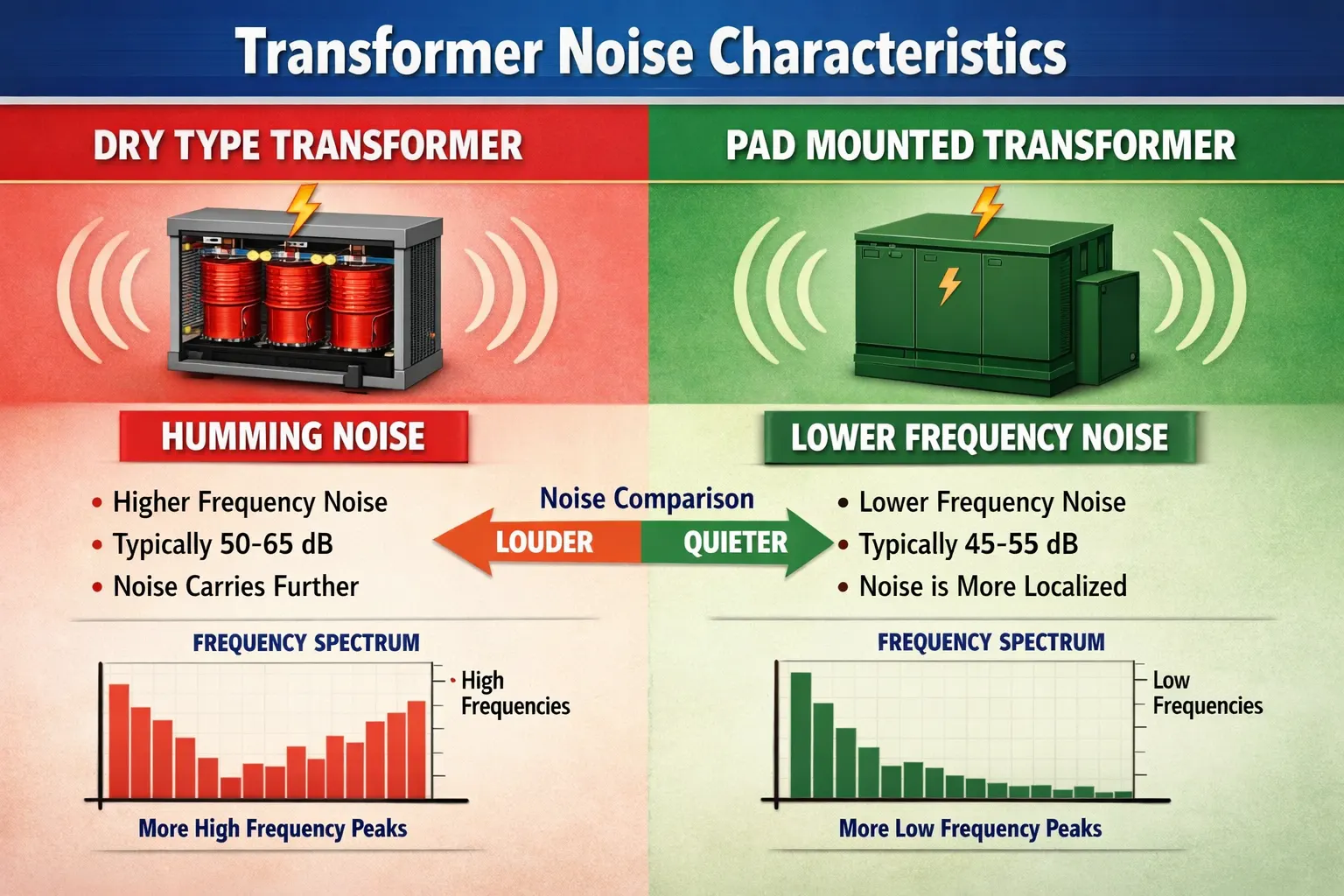
7. Dry Type vs Pad Mounted Transformer Noise Characteristics
Dry-type transformers and pad-mounted transformers exhibit distinctly different noise characteristics. Dry-type transformers, being air-cooled and without oil damping, typically produce higher audible hum levels (55–65 dB(A)) and transmit more structure-borne vibration, making them louder in indoor installations. Pad-mounted transformers, often oil-immersed and installed outdoors, generally operate at 60–72 dB(A) but benefit from oil damping and heavy enclosure mass, resulting in lower perceived noise indoors. However, their larger size and foundation mounting can still generate significant low-frequency vibrations if not properly isolated. Understanding these differences is crucial when selecting vibration isolators and soundproofing strategies to effectively reduce transformer hum in each application.
|
Feature |
Dry Type Transformer |
Pad Mounted Transformer |
|
Installation |
Indoor |
Outdoor |
|
Cooling Method |
Air |
Oil |
|
Noise Damping |
Lower |
Higher due to oil |
|
Noise Control |
Easier with panels |
Requires barriers/enclosures |
8. Engineering Case Study: Practical Noise Reduction in Export Projects
In real export scenarios, transformer noise control is often dictated by local regulations (e.g., EU environmental noise directives) and customer expectations. Below is a typical engineering workflow applied by a transformer manufacturer supplying to European markets.
Project Background
- Equipment: 1000 kVA pad-mounted transformer
- Location: Residential distribution area
- Initial Noise Level: 68 dB(A) at 1 meter
- Target Noise Level: ≤ 55 dB(A)
Implemented Solutions
|
Step |
Solution |
Result |
|
1 |
Reduced flux density by 8% |
-3 dB |
|
2 |
Installed spring vibration isolators |
-5 dB |
|
3 |
Added acoustic enclosure |
-7 dB |
|
4 |
Optimized core clamping |
-2 dB |
Final Outcome
- Achieved Noise Level: 53 dB(A)
- Compliance: Meets EU residential standards
- Customer Satisfaction: High
Insight: Combining multiple techniques is significantly more effective than relying on a single method.
9. Selection Guide: Choosing the Right Noise Reduction Solution
Different transformer types and installation environments require tailored approaches.
9.1 Quick Selection Matrix
|
Scenario |
Recommended Solution |
Priority Level |
|
Indoor dry-type transformer |
Acoustic panels + rubber isolators |
High |
|
Outdoor pad-mounted transformer |
Noise barriers + enclosure |
High |
|
Spring isolators + core optimization |
Critical |
|
|
Retrofit projects |
External soundproofing |
Medium |
10. Compliance with International Noise Standards
For global export, understanding and complying with international standards is essential.
Key Standards
- IEC 60076-10: Determination of transformer sound levels
- ISO 3746: Acoustic measurement methods
- EU Environmental Noise Directive (END)
Typical Noise Limits
|
Environment |
Acceptable Noise Level |
|
Residential (night) |
40–55 dB(A) |
|
Commercial |
55–65 dB(A) |
|
Industrial |
65–75 dB(A) |
11. Design Optimization for Transformer Manufacturers
From a production standpoint, integrating noise reduction at the design phase provides the highest ROI.
11.1 Core Optimization
- Use step-lap joints
- Minimize air gaps
- Improve lamination stacking precision
11.2 Winding Structure Enhancement
- Increase mechanical rigidity
- Use epoxy resin casting (for dry-type transformer)
- Reduce electromagnetic vibration
11.3 Tank and Enclosure Design
- Reinforce weak structural points
- Avoid large flat panels prone to resonance
- Apply damping coatings
12. Cost vs Performance Analysis
Balancing cost and effectiveness is crucial in competitive export markets.
|
Solution |
Cost Level |
Noise Reduction |
ROI |
|
Rubber isolators |
Low |
Moderate |
High |
|
Spring isolators |
Medium |
High |
High |
|
Acoustic enclosure |
High |
Very High |
Medium |
|
Core redesign |
High |
Very High |
Long-term |
Recommendation:
- For OEM (transformer manufacturer): focus on design optimization
- For EPC/installation teams: prioritize vibration isolation and enclosures
13. Future Trends in Transformer Noise Reduction
The industry is evolving toward smarter and quieter solutions:
13.1 Smart Monitoring Systems
Real-time sensors track noise levels, vibration, and load conditions.
13.2 Advanced Materials
- Amorphous core materials (ultra-low magnetostriction)
- Composite damping structures
13.3 Digital Twin Technology
Simulation-driven optimization allows engineers to predict transformer hum before manufacturing
FAQ
Q1: What is the main cause of transformer hum?
Magnetostriction in the core is the primary source of transformer hum.
Q2: How can vibration isolators reduce transformer noise?
They prevent vibration transfer from the transformer to the supporting structure.
Q3: Are pad-mounted transformers quieter than dry-type transformers?
Generally, yes, due to oil damping, but they still require noise control measures.
Q4: How do magnetic fields reduce transformer noise?
Optimized magnetic fields reduce magnetostriction, which directly lowers vibration and sound.
Q5: What is the best way to reduce transformer core noise?
Use high-quality core materials, step-lap design, and control flux density.
Q6: Can existing transformers be made quieter?
Yes, through retrofitting with vibration isolators, acoustic enclosures, and structural reinforcement.
Reducing transformer hum requires an integrated engineering approach combining mechanical isolation, electromagnetic optimization, and acoustic treatment. Whether applied to a dry type transformer in a commercial facility or a pad mounted transformer in a residential environment, these strategies effectively minimize transformer hum and improve operational performance.
For any transformer manufacturer, implementing these solutions at both design and installation stages is essential to meet global standards, reduce customer complaints, and enhance product value in international markets.

Related Articles





Related Products
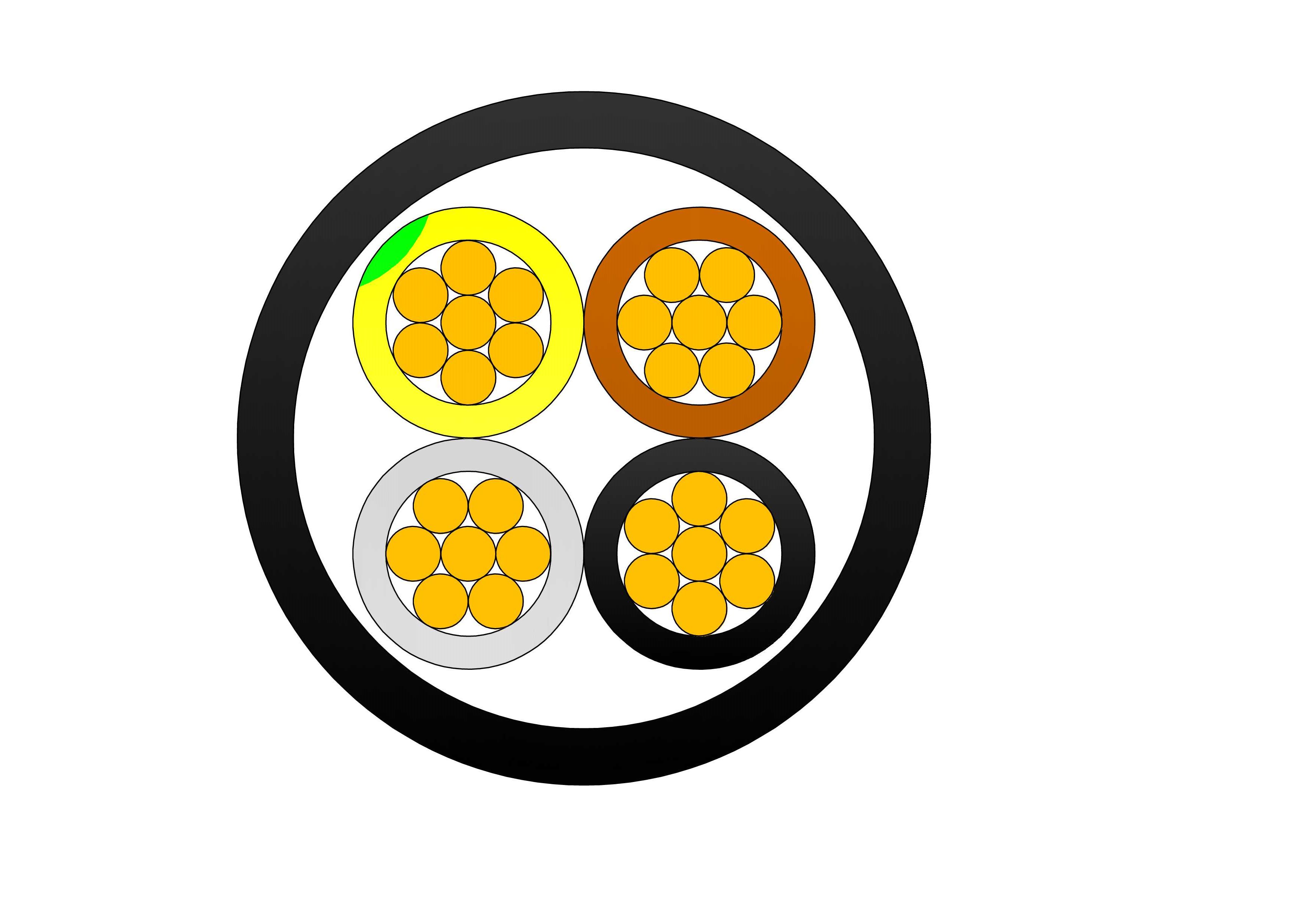
4/5 Cores Copper Cable CU/XLPE/PVC 0.6/1kV
The 4/5 Cores Copper Cable CU/XLPE/PVC 0.6/1kV is engineered for reliable low-voltage power distribution in industrial, commercial, and infrastructure applications. Constructed with high-conductivity stranded copper conductors, premium XLPE insulation, and a durable PVC outer sheath, the cable provides excellent electrical performance, thermal stability, and mechanical protection. The XLPE insulation enables continuous conductor operating temperatures up to 90°C while maintaining outstanding dielectric strength and insulation reliability. The PVC sheath protects against moisture, abrasion, oils, chemicals, and environmental stresses, ensuring long service life in demanding installations. Available in both 4-core and 5-core configurations, the cable is ideal for three-phase power distribution systems, industrial machinery, commercial buildings, utility projects, and electrical networks. Manufactured according to IEC 60502-1 standards, it guarantees safety, efficiency, and dependable performance. Custom conductor sizes, sheath colors, and packaging options are available to meet project-specific requirements. The 4/5 Cores Copper Cable CU/XLPE/PVC 0.6/1kV is a trusted solution for modern electrical infrastructure.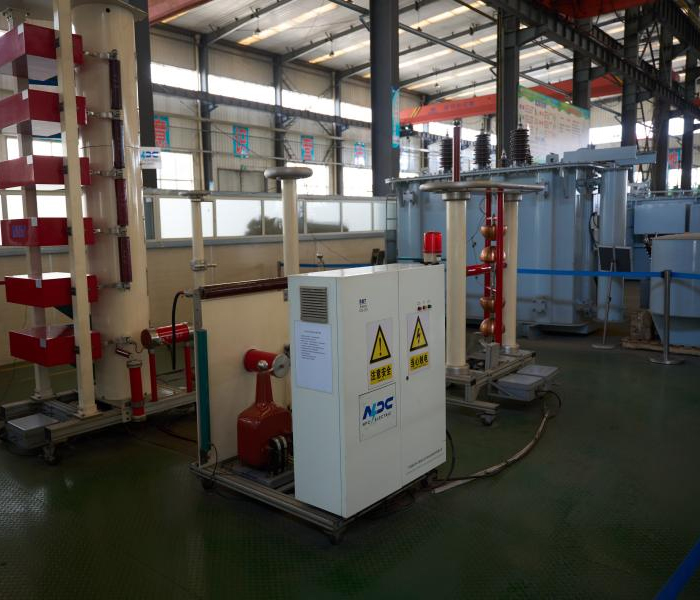
3000kVA Dry Type Transformer
3000kVA Dry Type Transformer is a high-performance, reliable power solution designed to meet the needs of large industrial and commercial facilities. With a 3000kVA capacity, it utilizes advanced dry-type insulation, ensuring exceptional safety, minimal maintenance, and extended durability. Built for demanding environments, this transformer provides stable, efficient, and low-noise operation while minimizing environmental impact. The NPC ELECTRIC 3000kVA Dry Type Transformer is the ideal choice for ensuring reliable and efficient power distribution in large-scale applications. Core features include three-phase design, primary voltages 208V–600V (e.g., 480V Delta, 600V Delta), secondary voltages such as 208Y/120V, 480Y/277V, or custom, aluminum or copper windings, 150°C rise (standard) or 115°C/80°C with 220°C insulation class, ±2×2.5% primary taps, NEMA 1 ventilated enclosure (NEMA 3R/encapsulated options), natural convection cooling (AN), electrostatic shielding, and low sound levels per NEMA.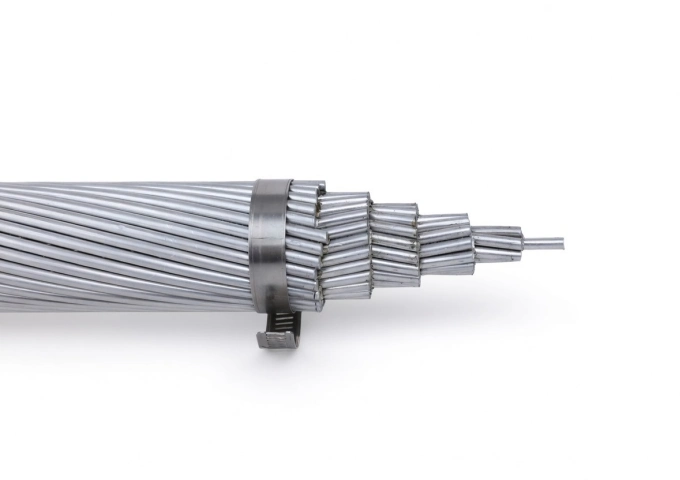
477 MCM Syringa AAC Cable
The 477 MCM Syringa AAC Cable is a high-performance All Aluminum Conductor designed for demanding overhead power transmission and distribution lines. Manufactured with 37 strands of premium 1350-H19 aluminum wire in a concentric lay configuration, this bare conductor provides excellent electrical conductivity with a low DC resistance of 0.0362 ohms per 1000 ft at 20°C. Featuring an overall diameter of 0.795 inches and a rated breaking strength of 8,690 lbs, the Syringa AAC delivers a robust ampacity of 639 amps while weighing only 447.8 lbs per 1000 ft. Its optimized strength-to-weight ratio minimizes sag and structural loading. Fully compliant with ASTM B-230 and B-231 standards, the 477 MCM Syringa AAC Cable offers outstanding corrosion resistance for long-term durability in harsh outdoor environments, making it the preferred choice for utility networks requiring cost-effective, high-reliability bare aluminum conductors.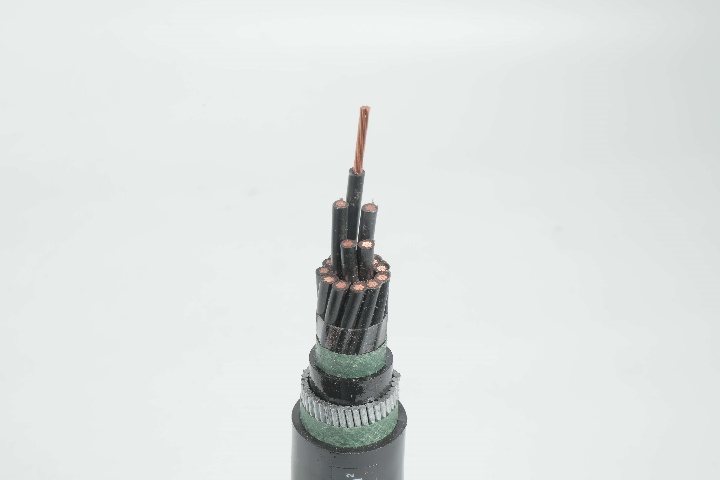
YY Control Cable (YSLY / HSLH) - 300/500V PVC & LSZH Flexible Control Cable
The YY Control Cable (YSLY / HSLH) is a highly flexible multi-core control cable designed for industrial automation, machinery, and building management systems. It features finely stranded copper conductors with PVC or halogen-free (LSZH) insulation, twisted cores, and a durable PVC or low-smoke zero-halogen outer sheath. Available in both standard PVC (YSLY) and flame-retardant low-smoke (HSLH) versions, this cable offers excellent flexibility, oil resistance, and reliable signal transmission. Rated 300/500V, it is suitable for indoor and protected outdoor installations. The YY Control Cable (YSLY / HSLH) undergoes strict quality testing from raw materials to finished product, ensuring consistent electrical performance, mechanical strength, and safety compliance with IEC 60227 and related standards.
75kVA Dry Type Transformer | High Efficiency Indoor Power Transformer
The 75kVA Dry Type Transformer is a compact, three-phase, high-efficiency indoor power transformer engineered for safe, reliable voltage transformation in commercial, institutional, and light industrial environments. Utilizing advanced cast-resin or vacuum pressure impregnated (VPI) insulation technology, it eliminates oil-related fire hazards, maintenance requirements, and environmental risks while delivering exceptional performance in confined spaces, high-rise buildings, hospitals, schools, data centers, office complexes, and renewable energy tie-in applications.2Y-high-voltage-power-cable-2.webp)
High Voltage / 2XS(FL)2Y, A2XS(FL)2Y 110kV Power Cable
2XS(FL)2Y / A2XS(FL)2Y 110kV High Voltage Power Cable is a longitudinally watertight, XLPE-insulated cable designed for primary power distribution up to 110kV (123kV highest). It features a Class 2 copper or aluminium conductor, extruded semi-conductive XLPE screens, and XLPE insulation applied via a three-layer co-extrusion process for superior electrical performance. A laminated aluminium or copper moisture barrier with copolymer coating provides excellent water and gas resistance, while HDPE oversheath ensures high abrasion resistance and flexibility. The copper wire screen with counter-helical copper tape offers optimal shielding, and water swellable tapes ensure longitudinal water blocking. Manufactured to IEC 60840, HRN HD 632, and IEC/EN 60228 standards, this cable is ideal for underground installations requiring high reliability and moisture protection.
397.5 MCM Canna AAC Cable
The 397.5 MCM Canna AAC Cable represents premium All Aluminum Conductor technology for overhead power applications. Built with 19 strands of high-conductivity 1350-H19 aluminum, this bare conductor delivers an optimal balance of electrical efficiency and mechanical robustness. With a 0.724-inch diameter, 7,110 lbs breaking strength, and 570 amps ampacity, the Canna AAC offers low DC resistance of 0.0435 ohms per 1000 ft at 20°C and a weight of 373.2 lbs per 1000 ft. This design minimizes sag while providing excellent corrosion resistance for extended outdoor service. Manufactured to meet ASTM B-230 and B-231 standards, the 397.5 MCM Canna AAC Cable undergoes extensive quality testing from raw materials through finished product. It is the perfect solution for new installations and upgrades in transmission and distribution systems that demand lightweight, high-conductivity bare aluminum conductors.SHTOU-mining-cable-2.webp)
(N)SHTOU-O/J PUR 0.6/1kV Cable
(N)SHTOU-O/J PUR 0.6/1kV cable is a flexible, rubber-insulated low voltage power and control cable manufactured according to VDE 0250 standards. Designed for harbour cranes, conveyors, mining equipment, and other heavy-duty mobile machinery, it offers exceptional mechanical strength, oil resistance, flame retardancy, and flexibility under high dynamic loads. Its halogen-free polyurethane (PUR) sheath ensures outstanding abrasion resistance, long service life, and reliable performance in demanding indoor and outdoor environments. Capable of withstanding torsional stress, high tensile loads, and fast operating speeds, this cable is ideal for applications requiring durability and operational safety.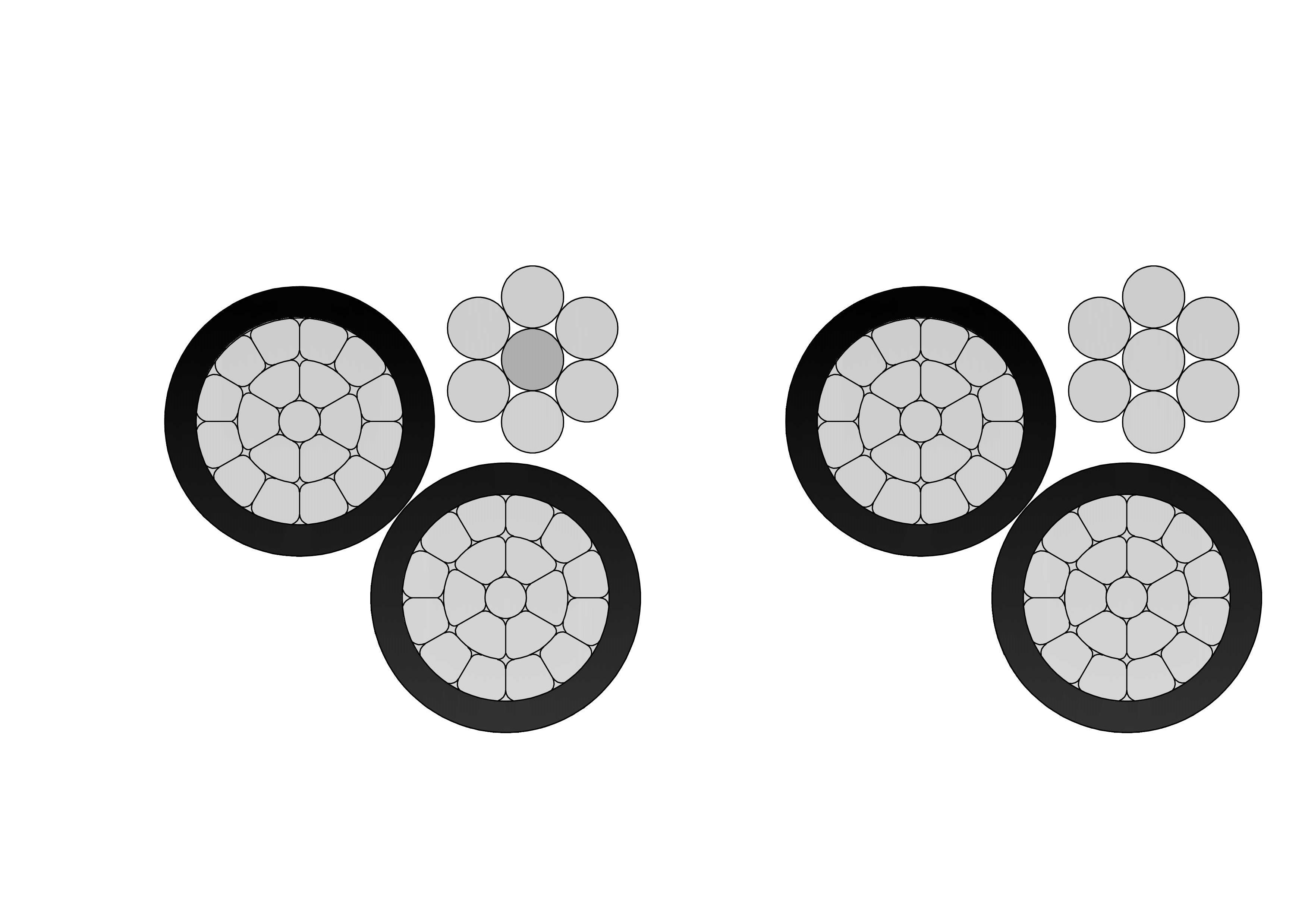
4 Barnacles Aluminum Conductor Triplex Overhead Service Drop Cable
The 4 Barnacles Aluminum Conductor Triplex Overhead Service Drop Cable is designed for reliable overhead electrical service connections in residential and light commercial utility distribution systems. The cable structure includes two insulated aluminum phase conductors twisted around a bare aluminum neutral messenger, providing stable electrical transmission and dependable mechanical support. Manufactured using high-quality aluminum and durable weather-resistant insulation compounds, the 4 Barnacles Aluminum Conductor Triplex Overhead Service Drop Cable offers low electrical resistance, strong corrosion resistance, and long service life in outdoor environments. Its optimized conductor construction allows efficient installation while maintaining adequate tensile strength for aerial applications. The cable is engineered to perform reliably under UV exposure, wind loading, and temperature variation. Comprehensive quality management systems and standardized testing procedures are implemented throughout production to ensure compliance with utility and industry standards and to deliver consistent, dependable performance in service.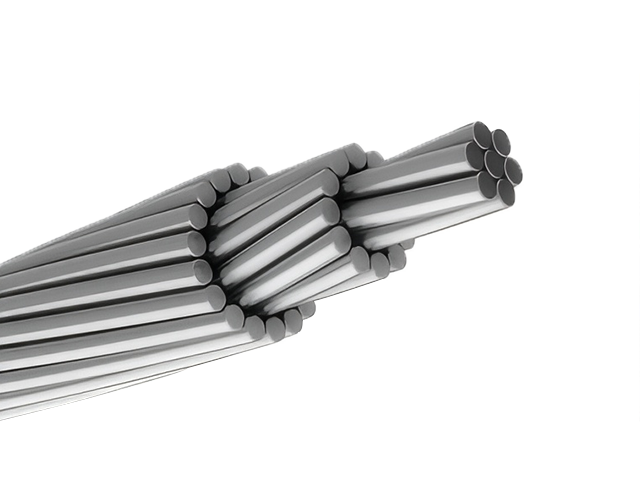
1033.5 MCM ORTOLAN ACSR Conductor Cable
The Ortolan ACSR Conductor Cable is a high-capacity overhead conductor designed for efficient power transmission. Named "Ortolan" for its 1033.5 MCM size with 45/7 stranding (45 aluminum wires around 7 steel cores), it combines lightweight aluminum for conductivity with a galvanized steel core for tensile strength. Compliant with ASTM B230, B232, and ICEA standards, this cable offers a breaking load of approximately 32,300 lbs and a current rating up to 1000 amps at 75°C in overhead applications. The aluminum 1350-H19 provides excellent corrosion resistance and low electrical resistance (0.0166 Ω/1000ft at 20°C), while the steel enhances sag control over long spans. Suitable for voltages up to 230kV in distribution lines, the Ortolan ACSR Conductor Cable minimizes line losses and withstands harsh weather, including wind and ice loading. Its cost-effective design makes it popular for utility upgrades and rural electrification, ensuring reliable power delivery with minimal maintenance in overhead transmission and distribution systems worldwide.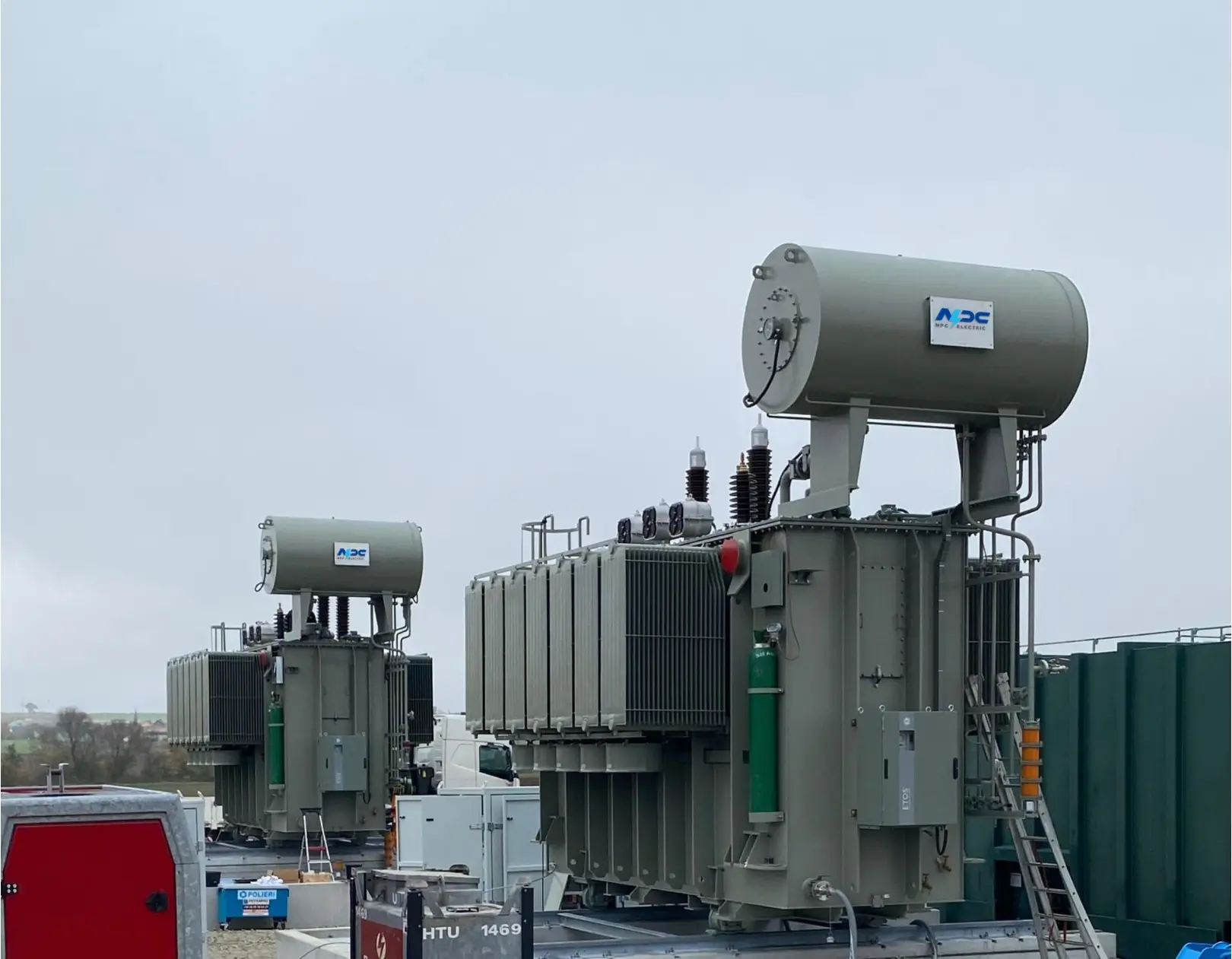
500kV Oil-Immersed Power Transformer For Ultra-High Voltage Grid Solutions
NPC Electric 500kV Oil-Immersed Power Transformer is a critical component for national ultra-high voltage (UHV) backbones, engineered to transmit massive blocks of power with industry-leading efficiency. Utilizing premium, laser-scribed CRGO silicon steel in a multi-step lap core construction, this transformer minimizes magnetizing current and core noise. The active part is submerged in high-grade inhibited mineral oil, processed through advanced vacuum degasification to ensure maximum dielectric strength. Its robust, shield-type winding structure provides exceptional resistance against lightning surges and short-circuit mechanical stresses. Designed to meet IEC 60076 and IEEE standards, this 500kV unit is the definitive solution for long-distance energy dispatch, connecting remote generation hubs to major load centers while maintaining grid frequency and voltage stability.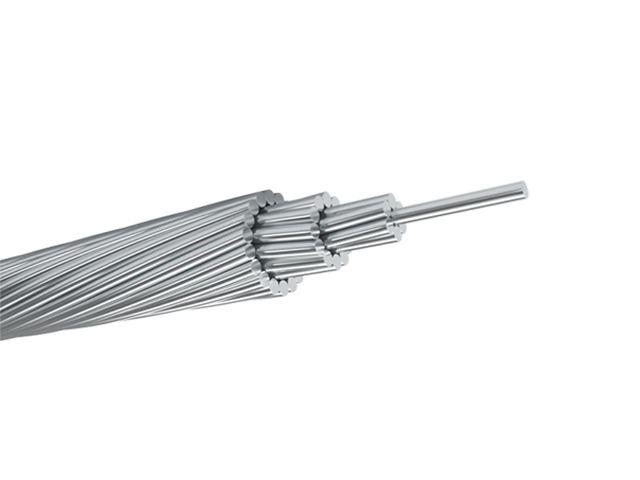
CAIRO AAAC Conductor Cable
CAIRO AAAC (All Aluminum Alloy Conductor) cables comply with ASTM B399 standards and offer high tensile strength, good conductivity, and resistance to corrosion. Named "Cairo" for its 600 mm² nominal area with 61-strand configuration, it offers superior conductivity (53% IACS) and tensile strength (295 MPa min) compared to ACSR. Made from heat-treated aluminum-magnesium-silicon alloy (6201-T81), this cable provides excellent corrosion resistance, low weight, and reduced sag for longer spans. Compliant with ASTM B398, B399, IEC 61089, and BS EN 50182 standards, it supports voltages up to 33kV with ampacity up to 1000A at 75°C. The homogeneous alloy construction eliminates bimetallic corrosion and ensures uniform mechanical properties. The Cairo AAAC Conductor Cable minimizes line losses, withstands harsh weather, and requires minimal maintenance. Ideal for rural electrification, urban upgrades, and renewable energy integrations, it delivers reliable, cost-effective power in overhead lines worldwide, outperforming traditional conductors in corrosive or coastal environments.
1/0 Gammarus Aluminum Conductor Triplex Overhead Service Drop Cable
NPC Electric 1/0 Gammarus Triplex Service Drop Cable provides reliable overhead secondary distribution for residential applications. Consisting of two 1/0 AWG aluminum phase conductors and one neutral messenger (7-strand) insulated with cross-linked polyethylene (XLPE) and twisted in triplex form, it meets ASTM, ICEA, and international standards. The robust insulation resists sunlight, moisture, and mechanical damage for decades of outdoor service. Lightweight design simplifies installation with low sag and easy handling. The 1/0 Gammarus Triplex Service Drop Cable ensures minimal losses, high current capacity, and excellent weather performance up to 600V. Self-supporting messenger reduces pole loading. Flame-retardant options enhance safety. Commonly chosen for two-phase power delivery with neutral in subdivisions, rural homes, and temporary connections requiring safe, economical aerial bundled solutions with proven durability.
121kV Oil-Immersed High-Voltage Power Transformer
The 121kV Oil-Immersed High-Voltage Power Transformer is designed to provide stable, efficient, and long-term power transformation for transmission networks and high-voltage substations. Utilizing high-quality silicon steel cores and precision-wound copper conductors, the transformer achieves low no-load losses, strong short-circuit withstand capability, and excellent thermal stability. The oil-immersed insulation and cooling system ensures effective heat dissipation, supporting continuous operation under heavy-load and fluctuating grid conditions. Its reinforced tank structure, advanced insulation system, and outdoor-rated protection design enable reliable performance in harsh climates and demanding environments. Manufactured in accordance with IEC, IEEE, and ANSI standards, this transformer is widely applied in utility grids, industrial power systems, and infrastructure projects requiring high reliability, safety, and long service life.
DARIEN AAAC Conductor Cable
DARIEN AAAC (All Aluminum Alloy Conductor) cables are manufactured in compliance with ASTM B399 and IEC 61089 standards, offering excellent conductivity, high tensile strength, and outstanding corrosion resistance. With 700 mm² nominal area and 61-strand construction, it features heat-treated aluminum-magnesium-silicon alloy (6201-T81) for enhanced strength (295 MPa min) and conductivity (53% IACS min). Meeting ASTM B398, B399, IEC 61089, and BS EN 50182 standards, this cable supports ampacity up to 1100A at 75°C and voltages up to 33kV. The uniform alloy eliminates bimetallic issues, offering superior corrosion resistance in harsh environments compared to ACSR. Low weight reduces sag and installation costs, enabling longer spans. The Darien AAAC Conductor Cable provides minimal electrical losses, high mechanical endurance, and excellent weather tolerance. Flame-retardant options available. Suited for urban grids, renewable connections, and coastal installations, it ensures cost-effective, maintenance-free power delivery in overhead systems globally, outperforming traditional conductors in reliability and lifespan.Welcome your inquiry
Honesty, Integrity, Frugality, Activeness and Passion